-
Title
-
Moss
-
Creator
-
Zhou, Zhiye
-
Abstract
-
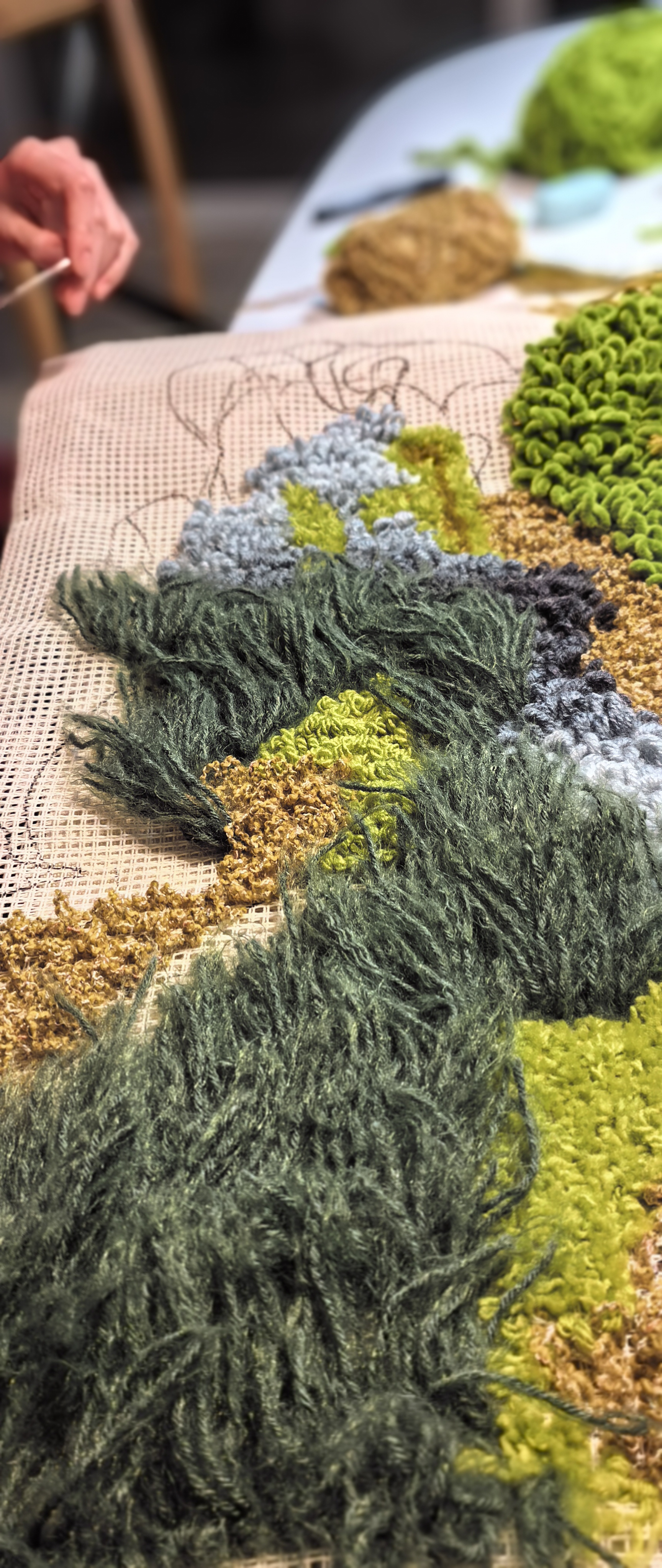
The sculpture Moss is a soft sculpture carpet which weaved with yarns to mimic the feature of nature. The intention of creating the Moss Carpet is to interact within the natural environment, meanwhile attach to the physical surroundings. The carpet is weaved with various yarns, in differing color and texture, which combined together presenting the organic form of moss and natural fibers. The sculpture represents the combination of the tradition technique in weaving and the fragility of nature, while conveying the feminine quality associated with the fabric sculpture. Psychologically, the work evokes a sense of curiosity and intimacy. The nature quality of the softness and warmth in yarn invites engagements mentally, makes the viewer want to touch and feel the piece.
-
Artist Statement
-
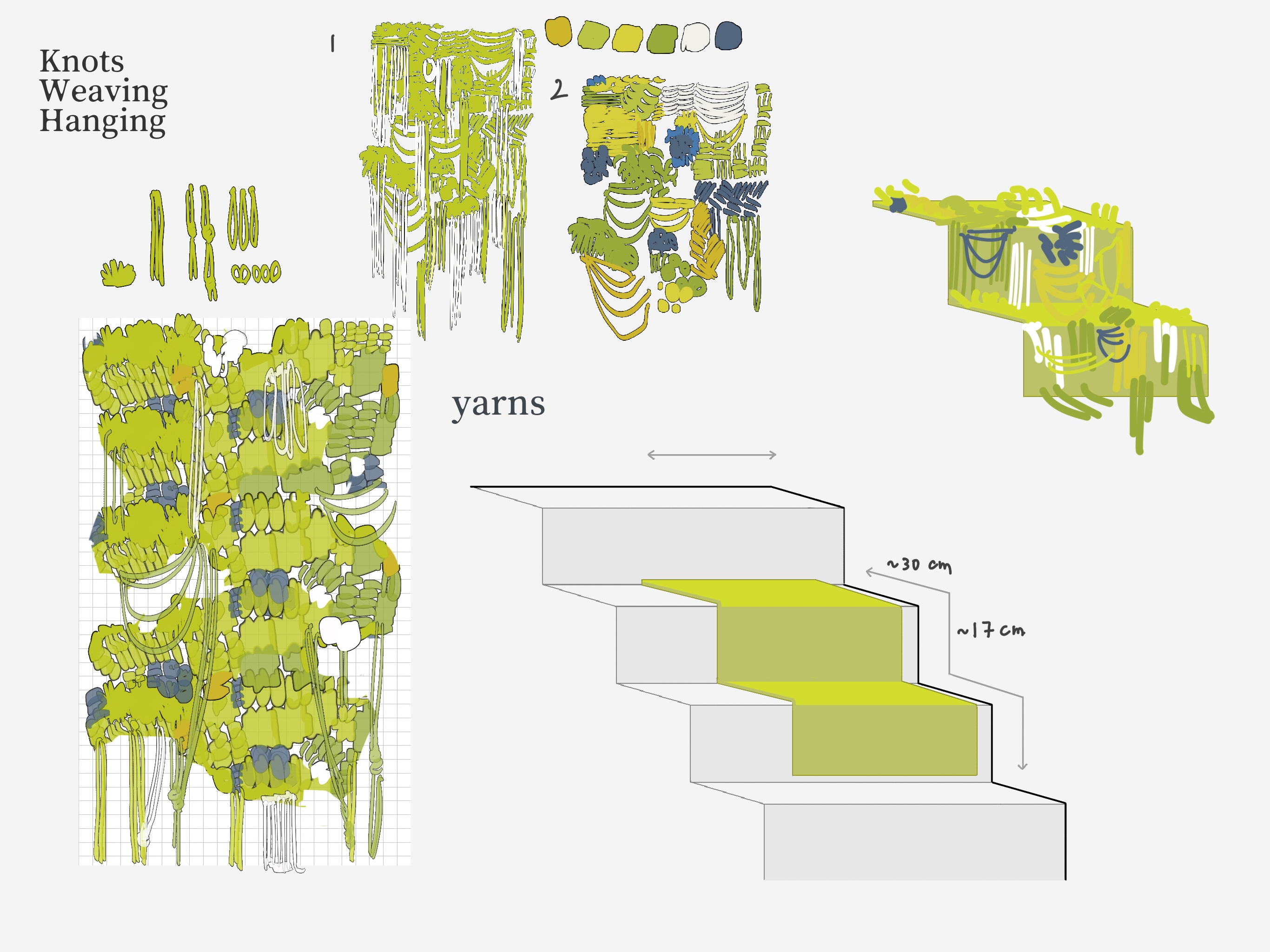
In this site-specific sculpture assignment, I created and installed my work, the Moss carpet on the campus staircase near the woods. My intention of creating the Moss Carpet is to interact within the natural surroundings, meanwhile attach to the physical surroundings. The carpet is weaved with various yarns, in differing color and texture, which combined together to mimic the organic form of moss and natural fibers. The threads are hanging loosely from the staircase, gradually flow over the steps, creating the sense of softness and fluidity of nature. The sculpture represents the combination of the tradition technique in weaving and the fragility of nature, while conveying the feminine quality associated with the fabric soft sculpture. The sculpture intentionally creates the natural irregularity of the yarns, falling or drooping randomly, thus emphasizing the impermanent nature of both the sculpture and the environment. Physiologically, the unexpected softness and form of the yarn against the hard, grey stone staircase interrupts the regular path of movement and forces the viewer to pause or alter their walking pattern. The small shift in the site echoes with the physical space in thej environment. Psychologically, the work evokes a sense of curiosity and intimacy. The nature quality of the softness and warmth in yarn invites engagements mentally, makes the viewer want to touch and feel the work. The idea also comes from the nature as I initially noticed the moss on the trunks and wanted to create a work to represent the same feeling at the moment. Moreover, the sculpture aims to coexist with the surrounding landscape, transforming the stairs into a place of interaction rather than just a path. In installation process of the piece, I applied three-dimensional principles such as gravity, solid weight, and balance. The yarn hangs according to its weight and fiber structure, as there is no rigid fame of the fabric, instead the piece alters in a organic way. The gravity decides the form and changes it in every moment, thus mimics the natural appearance of plants. On the other hand, the work focuses more on the process itself, which is the process of weaving, and considering it as an important aspect of the work.
This work is heavily inspired two female artists in the soft sculpture field, Eva Hesse and Sienna Martz, who played important role in shaping my approach to Moss Carpet, specifically in terms of the definition of softness, the process of creation, and the themes of organic form and nature. Firstly, Eva Hesse’s work ‘Contingent’ provides me the understanding of how softness and fragility can be integrated into a minimalist aesthetic. In her work, she used cheesecloth and latex, resulting in a form which depicts uncertainty and vulnerability. The panels in Contingent were suspended in space, allowing the piece to move and swing in its surroundings, and the nature of the materials allowed the sculpture to shift, and change over time. Hesse’s idea of creating art that embraces unpredictable alternation is essential in inspiring Moss Carpet. In response to that, I wanted my sculpture to engage directly with its environment. The installation isn’t meant to remain fixed but to engage with the outside forces, such as gravity, wind and touch. According to Hesse’s words, “I’m interested in solving an unknown factor of art, solving an unknown factor of life,” as it echoed my own desire to work with uncertainty, embracing the unexpected movements in art. Secondly, Sienna Martz’s work introduced me to the idea of organic forms in sculpture. Martz uses vibrant colors and organic patterns of fabric in her pieces, which directly reflects the ecosystems and natural cycles. Inspired by her, I worked with yarns in colors that evoke the natural surroundings, which is the greens and yellows of moss. I wanted to highlight the contrast between the organic and the synthetic, as Martz does.
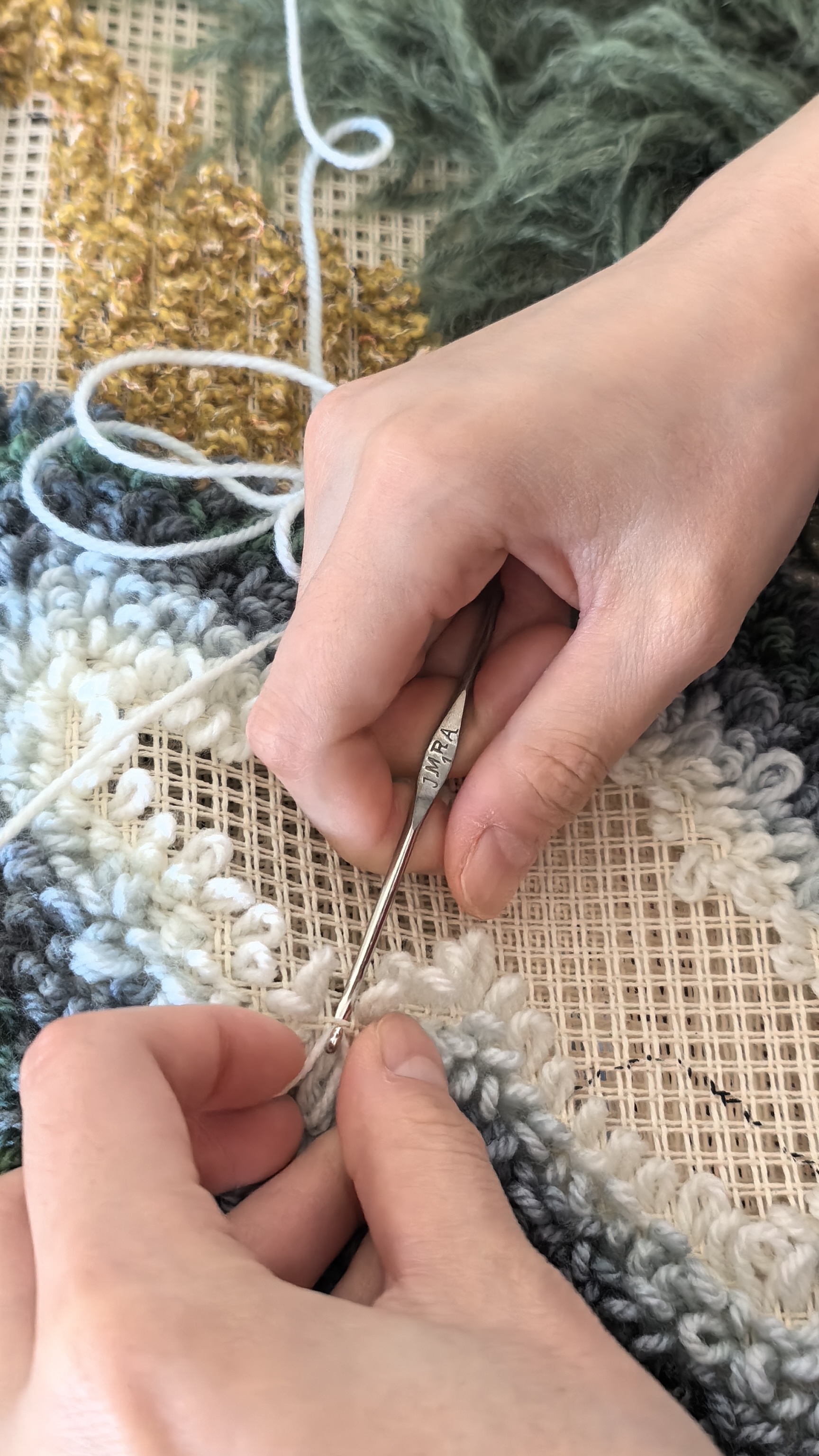
During the working stage, I realized that the process of making the work itself was just as important as the final outcome. I spent weeks weaving the yarns, choosing materials based on their texture and color. Based on different types of yarns, they present different results in its thickness, which directly leads to the volume of the final product. The physicality of the process including manipulating the yarn, weave in different techniques, cutting and arrangement was a meditative experience, which brings the process to another level, made it as important as the final product. The repetition of knotting and weaving became a pattern, drawing from Hesse’s Accession series, where repetitive action became the meaning in itself.
Ultimately, Moss Carpet is not just an aesthetic sculpture but an interactive piece for the viewer. It invites touch, curiosity, and interaction. Its softness encourages audiences to pause and observe, creating the dialogue between art, the environment, and the viewer. The piece serves as a reminder of our relationship to the environment, and the fragility of both nature and the human touch. Through Moss Carpet, I tried to celebrate the softness and impermanence, creating a work that transforms the everyday passage of a staircase into a moment of reflection on nature, femininity, and process. It invites a reconsideration of space and form through presence, tactility, and responsiveness to site.
-
Keywords
-
soft sculpture
-
natural
-
femininity
-
Subject
-
Visual Arts
-
Date Available
-
May 22-23, 2025
-
Course
-
AR3108 Sculpture ll
-
Instructor
-
Kotretsos, Georgia
-
Session
-
Visual Arts Exhibition
-
Location
-
Arts Center Gallery
-
Event
-
Year 2025 | 9th Annual Student Research and Creative Arts Symposium