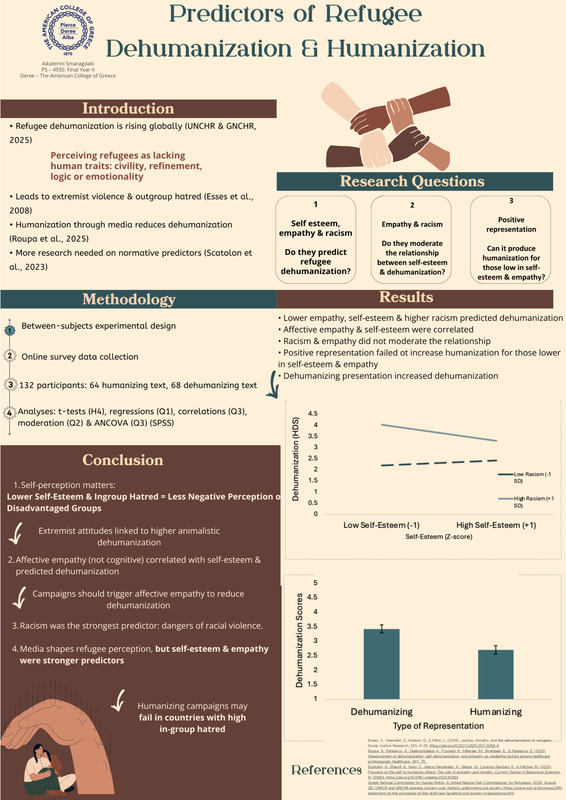
"Extremist attitudes towards refugees have increased in recent years, a phenomenon strongly
associated to their dehumanization. The literature establishes various predictors of outgroup
dehumanization, often derived from dark personality traits such as narcissism and sadism. This
research aims to further understand the perpetrators of refugee dehumanization, through the
measurement of normative personality traits such as self-esteem and empathy. Moreover,
understanding methods of refugee rehumanization was prioritized. To do so, two groups of
participants (N=132) were showcased two contrasting pieces of text that either humanized
(N=64) or dehumanized refugees (N=68). Participants were then measured for their levels of
self-esteem, empathy, refugee dehumanization as well as racism. It was found that all three
variables (self-esteem, empathy, racism) were significant predictors of refugee dehumanization,
with racism being the strongest. A correlation between levels of self-esteem and empathy was
also established. Further analysis showed that racism and empathy did not moderate the
relationship between self-esteem and dehumanization. Lower levels of empathy and self-esteem
were found to reduce the chances of rehumanization of refugees after positive presentation.
Lastly, the text presentation was found to be a strong influence on levels of refugee
dehumanization. These results, offer a greater theoretical understanding of who is more likely to
dehumanize refugees and as a result support extremist action towards them. Furthermore, an in
depth understanding of how refugee presentation can facilitate their dehumanization has been
offered. "
"Intimate partner cyberstalking (ICPS) is an emerging digital form of abuse. However, its mechanisms are poorly understood. The study explored gender, age, partner-related obsession, and sense of control as predictors of ICPS. Sixty-four participants completed self-report questionnaires measuring ICPS perpetration, partner-related obsessive-compulsive symptomatology, and sense of control. Results showed that gender significantly predicted ICPS, with females exhibiting higher perpetration. Prior cyberstalking experience further predicted ICPS, indicating a reciprocal victimisation-perpetration relationship. Age and sense of control did not significantly predict ICPS. Oppositely, partner-related obsession robustly predicted ICPS. Results suggest that ICPS may operate as dysfunctional reassurance-seeking behaviour and pinpoint the contribution of cognitive psychopathology in online intimate partner violence."
A collaboration project between a Visual Artist and a Physiotherapist dedicated to our loved ones who have gone / are going through Alzheimer’s. It is an artistic representation of what dementia patients going through based on events experienced through our lives as caretakers.
This essay confronts the ought-is problem and the universalism-relativism debate by proposing "rational moral essentialism," a framework grounded in minimal, rational criteria for morality. Drawing from thinkers like Hume, Moore, and Kondylis, it argues that morality requires proportionality, necessity, relevance, sustainable coexistence, and respect for human dignity. Rather than searching for universal virtues, it identifies universalizable wrongs, aiming to safeguard meaning against barbarism and amorality. The framework emphasizes practical dialogue and shared ethical boundaries across diverse cultural contexts, while critically avoiding the pitfalls of both moral absolutism and cultural relativism.
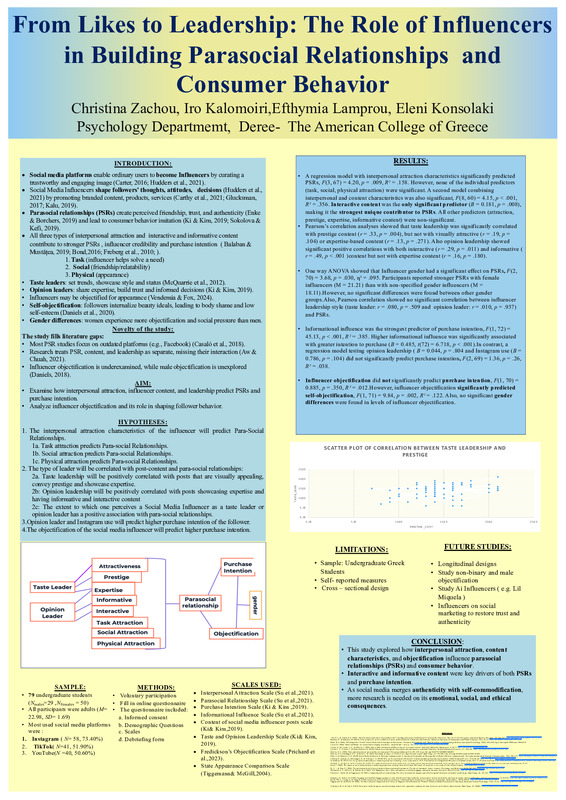
This study investigates the factors influencing parasocial relationships (PSRs) with social media influencers and how these impact purchase intentions, focusing on Instagram and TikTok. Despite the increasing prominence of influencers in digital spaces, research has yet to fully explore how interpersonal attraction, content style, leadership traits, platform-specific features, and influencer objectification affect PSR formation and strength. Notably, influencer’s objectification and its impact on consumer behavior remains understudied. This thesis addresses these gaps by analyzing influencer-follower dynamics in a competitive online environment, offering insights for marketers, influencers, and scholars in digital communication, marketing strategy, and consumer psychology.
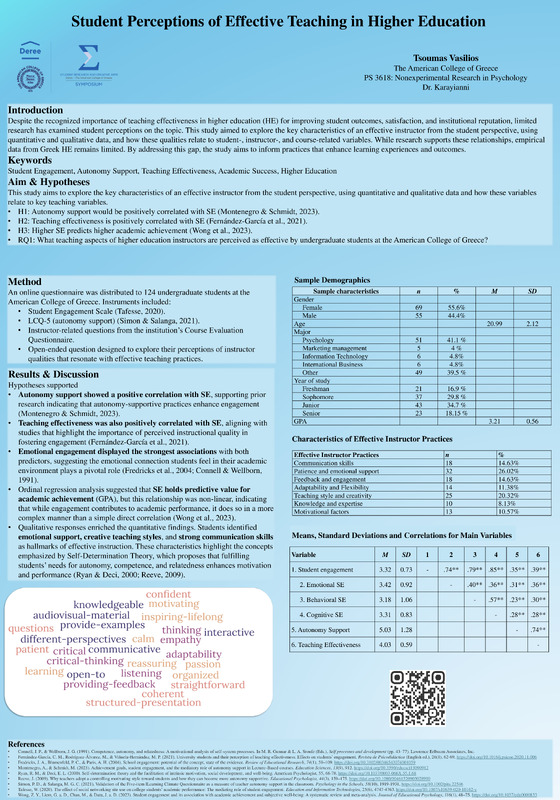
Abstract: Despite the recognized importance of teaching effectiveness in higher education (HE) for improving student outcomes, satisfaction, and institutional reputation, limited research has examined student perceptions on the topic. This study aimed to explore the key characteristics of an effective instructor from the student perspective, using quantitative and qualitative data, and how these qualities relate to student-, instructor-, and course-related variables. One hundred twenty-four undergraduate students from Deree ACG participated in an online survey by completing instructor-related questions from the institution's Course Evaluation Questionnaire and an open-ended question designed to explore their perceptions of instructor qualities that resonate with effective teaching practices. The findings indicate that student engagement was a predictor of academic achievement and positively corelated with autonomy support and teaching effectiveness. Ordinal regression analysis suggested student engagement had some predictive value over academic achievement. Students identified emotional support, creative teaching styles, and communication skills as important characteristics of effective teaching. The findings can inform teaching practices, professional development programs, and institutional policies, to improve student satisfaction and learning outcomes.
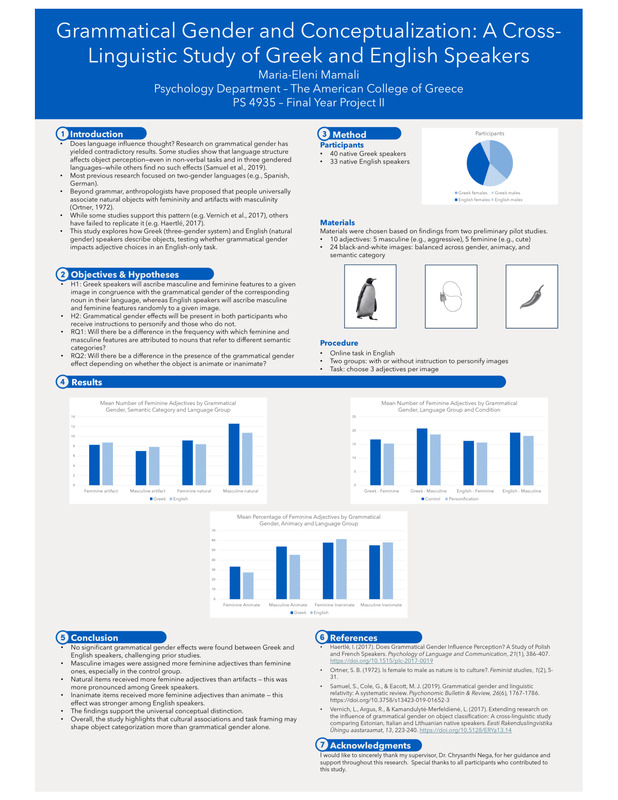
Forty native speakers of Greek and 33 of English viewed 24 images of items with masculine or feminine grammatical gender in Greek. The study, conducted in English, asked half the participants to personify each image before selecting three adjectives from a list of ten; the rest selected without personifying. No clear grammatical gender effect was found. Both groups used more feminine adjectives for natural and inanimate images—Greek speakers more so for natural, and English speakers for inanimate. Grammatically masculine pictures received more feminine adjectives by both groups, and the non-personification condition used more feminine adjectives overall.
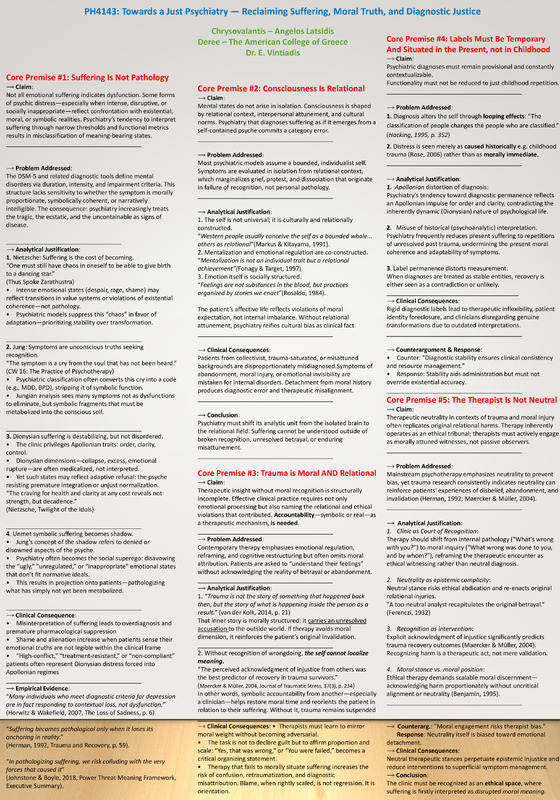
This treatise confronts the foundations of modern psychiatry, arguing that its pursuit of normalization has severed suffering from its existential, relational, and ethical contexts. Drawing on existential philosophy (Heidegger, Levinas, Camus), psychiatric critique (Bracken, Cooper), and trauma studies (van der Kolk), it demands a re-founding of psychiatry not on optimization, but on tragic solidarity. Rejecting both pathological romanticism and mechanical symptom-management, the work envisions a psychiatry that sustains fracture without erasing it, honors relational wounding, and redefines healing as the courageous accompaniment of irreparable lives. Psychiatry must cease diagnosing malfunction and become a faithful witness to human brokenness.
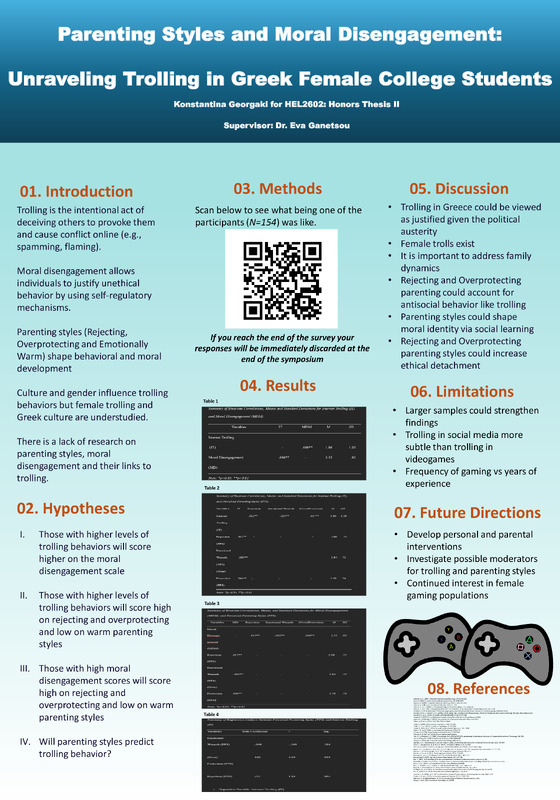
This thesis examined the relationship between moral disengagement, parenting styles and trolling behavior in Greek female college students (N=154), testing whether parenting styles could predict trolling. Participants completed the GAIT, MDM, and (s)-EMBU scales. Trolling was positively correlated with moral disengagement, rejection, and overprotection and negatively correlated with warm parenting styles. Moral disengagement showed similar correlations, and parenting styles weakly predicted trolling. Findings suggest a link between trolling, moral disengagement and parenting styles, contributing to existing literature. Some limitations include time constraints and sample size. Future research can work on developing interventions and exploring moderators between trolling and parenting styles.
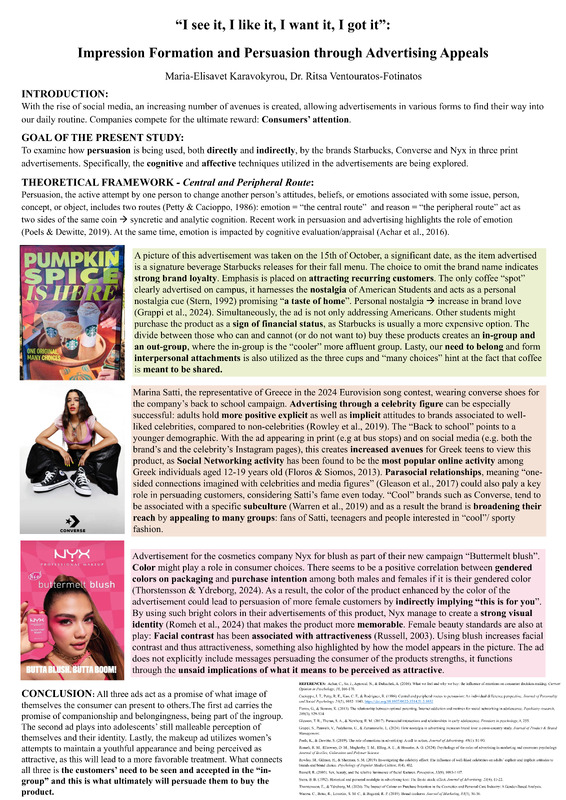
With the rise of social media, increasing avenues are created, allowing for advertisements in various forms to find their way into our daily lives. The present study examines how three advertisements utilize cognitive and affective techniques to persuade consumers to buy their products: A Coffee Drink; Sneakers; and Make-up. Regarding persuasion tactics, the ads were connected to the customer’s nostalgia and their need to belong in the ‘in-group’, their identity, and their desire to present themselves as young and attractive. Lastly, specific connections are made to target age groups or ethnicities that are more likely to be persuaded by each advertisement.