Convergence is an interactive, browser-based game, in which players explore the intersection of digital identity, immersive technology, and ethical dilemmas. It is set in a future society where VR headsets are implanted, and the protagonist must engage in an environment of fragmented memories and moral questions. Combining narrative storytelling, symbolic puzzles, and visual design, the game engages players emotionally and intellectually, while also being inspired by philosophical themes and emerging technological trends. The game challenges its players to reflect on the concepts of autonomy, memory, and interpersonal relationships, through interactive storytelling, psychology and the use of technology.
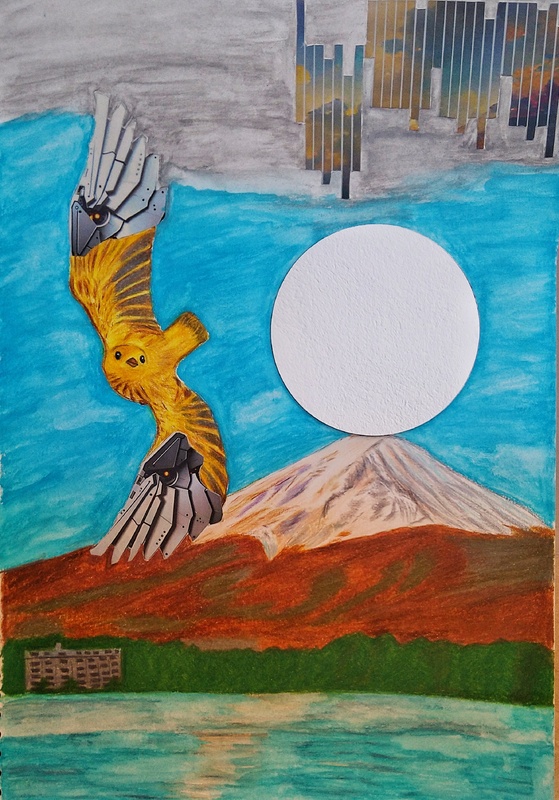
Life imitates art. But does Big Technology imitate life, or vice versa? As we know, technology has become an inevitable part of our lives to the point where the borders of the real world and digital become extremely blurry. Both Robotics’ and AI developments strive to be as human-like as possible. But have we reached the pinnacle of the humanity? And what will reaching it even entail? My artwork uses the metaphors of mirror, mountain, and canary with robotic wings to highlight the psychological, ethical, social and technological dimensions of AI and Robotics. The complimentary and contrasting colours depict the blend of virtual and real-life reality.
The creative project “The Awakening”, explores the intersection of artificial intelligence, robotics and ethics within both a dystopian and hopeful future. The goal was to create a compelling narrative, a modern fairytale inspired by course themes and engage the audience through a choose-your-own-adventure story format. To achieve this, I applied creative writing and AI generated images that substitute the classic illustrations in traditional fairytales. The player has the ability to explore different storylines each with a different outcome reflecting both a dystopian and an optimistic approach.
“Fragmented Identities” explores how the merging of humans and technology reshapes identity. Drawing from telepresence art and posthumanism, the work addresses themes of anonymity, disembodiment, omnipresence, and digital distortion. It reflects on how digital spaces mask, fragment, and reconstruct selfhood. Inspired by works like Eduardo Kac’s Time Capsule and Teleporting an Unknown State, and films like Her, the project visualizes how identity transcends physical boundaries, becomes fluid, and is often distorted. Ultimately, it questions whether digital representations can truly capture our essence or simply offer new, complex layers of being.
The work which will be presented is a book specifically designed for children of a young age, which helps them learn while playing. More specifically, the book consists of numerous categories, each of whom includes specific words and images. The kids have to match the right image of each category to the right word, which are in magnet form. Therefore, the kids get to learn in a fun and innovative way, with the help of their caregivers and later by themselves.
Marine turtles represent one of the most anatomically peculiar categories of animals, falling into two big taxonomical classifications, the Dermochelyidae and the Cheloniidae. The loggerhead Caretta caretta turtles belong to the Carettini division of the Cheloniidae family of Testudines. This thesis examined the genetic diversity of loggerhead turtles based on the genetic structure of a population of marine turtles from six nesting areas of Crete, Greece. This was a laboratory-based research project for which 95 individuals from Mediterranean grounds of the island of Crete were sampled and examined with the application of different molecular analysis and bioinformatics methods. From a conservation standpoint, as the subject of study is a threatened species, it is important to understand and research origins, migration pathways and nesting sites to comprehensively determine a conservation plan. Despite considering ecological importance, management, diversity and economy, conservation projects play an important role in shaping communities as there is a common ethical responsibility to preserve ecosystems and wildlife, part of the legacy for future generations.
As observed in the recent pandemic, the lack of standardization of microbiology education has lead to the lack of microbiology literacy. Considering how comics are entertaining and successful mediums at keeping their audience's attention and focus, young adult students may be able to learn microbiology through comics. "Bacterial Tales from Beyond The Microbiome" is a comic where the three main characters are the infamous Blue, Black, and White deaths. Their goal? To find who is the new mystery pathogen that is causing a pandemic and stop them.
The project is a comedic video, of me acting as someone who has taken the HHU/HSS 2206, Digital Citizenship course, but has no idea what it is about. I present 3 main topics discussed in the course, but as my character does not understand the contents, he doesn’t explain it well and faces many misfortunes due to it.
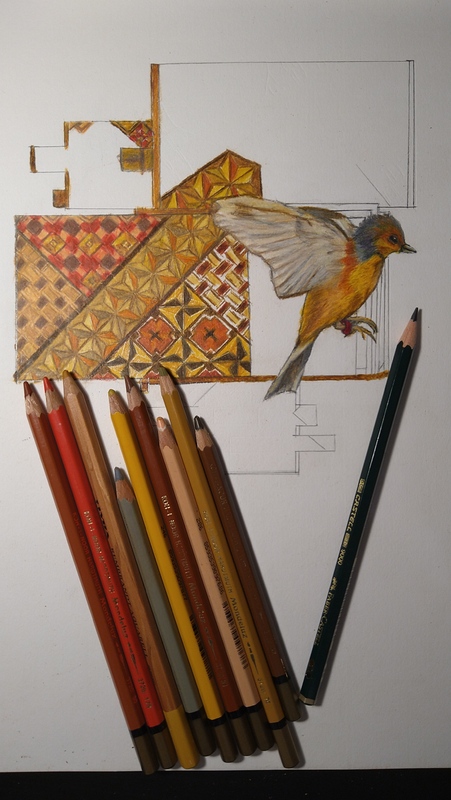
The age of Big Technology raises an important societal question: do we have a freedom of personal information that is an inseparable part of our identity in cyber space? My artwork reflects on two major opposite feelings regarding this issue using a bird as the most common symbol of freedom in art. The positive aspect of simplicity and freedom of IoT usage is portrayed in the overall composition: the bird flies away without being disturbed by a bracelet. Smart devices are akin to a mystery box that contains everything about us. Only external forces know how to unlock it. Equipped with the various sensors and connected to a smartphone, IoT devices are fully integrated into people’s and animals’ daily chores. And this also has a negative impact such as data privacy risks depicted in the data leakage metaphor and exposure of different data sheets.
https://chaffinchisthewitness.wordpress.com/
The goal of the project was to explore how art can influence and evoke political beliefs and it was conducted in two phases. In the phase we created a sculpture that depicts the head of an individual however in the place of the brain is parliament on fire. The inspiration for the sculpture came from class discussions and the name of the course, regarding brain regions and their functions, as well as how psychological constructs and research explain political views and behavior. In the second phase, we conducted a questionnaire in order to see people’s reactions to the art piece.