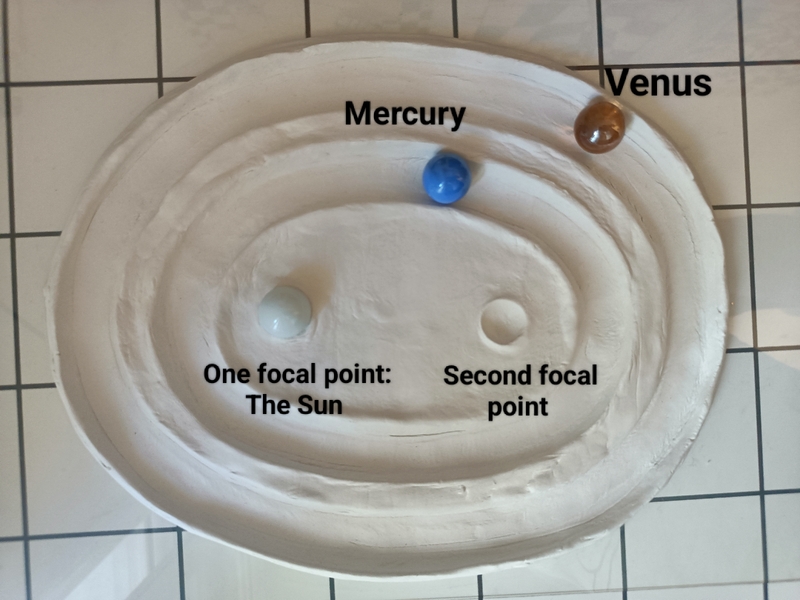
My creative project for the course HNS2250A1 Debunking Pseudoscience is an educational tool that assists me to debunk the pseudoscientific claim or concept of Mercury in retrograde. Mercury in retrograde, as seen from the Earth, is the apparent backward movement of Mercury in its orbit around the sun. However, this is an optical illusion because there is no planet in our solar system that goes in an opposite direction from the other planets (counterclockwise direction). Moreover, through my educational tool, made from clay, I can explain Kepler’s first law which explains that all planets including Earth are orbiting the Sun in an elliptical route. Furthermore, through Kepler’s work, I can show with my educational tool that the Sun is not at the center of the ellipse.
The Logomachean Method is a novella, a work of historical fiction set in ancient Athens in the very early Hellenistic period, after Alexander but shortly before the wars of the Diadochi. The story follows Logomaches, a brilliant but eccentric physician and scientist living in a pre-scientific and pre-medical era, who is called on to save Athens from a deadly epidemic, and who employs an early version of the scientific method to find the cure. However, public panic, superstition, time pressure and the intense political intrigues of Athens’s transitional regime under Macedonian occupation offer his chances of success a bleak prognosis.
Having explored the dimensions, ethical limitations and conditions under which poverty is represented through various mediums (literature, photography, videography, documentaries, theater) throughout the course of HHU 2208, my creative project aims to ethically and effectively represent three individuals (trans and non-binary).
The goal of my project was to portray that poverty can, in fact, be ethically represented if certain measures are cautiously applied. Moreover, as these three individuals (and a large plethora of the trans community), are facing a hard time in being able to afford hormones or surgeries, I had also created a fundraiser and encouraged my classmates to donate, reaching the total donation of 245 euros.
Lastly, this project aimed to point out that the financial issues that come with being trans, are not talked about enough; Not being able to cis-pass is life threatening, due to dysphoria as well as due to the anti-trans sentiment that may clock these individuals, leading to discrimination or violence.
This project, Do you feel guilt?, explores the emotional and ethical complexities of representing poverty through a personal and collective lens. Centered on a personal story and hosted on a website inviting others to share their own experiences, the project interrogates guilt, privilege, and authenticity. Rather than offering conclusions, it creates a medium for dialogue, where multiple perspectives coexist. Ultimately, it challenges the idea of representation and shifts focus from speaking for others to listening instead.
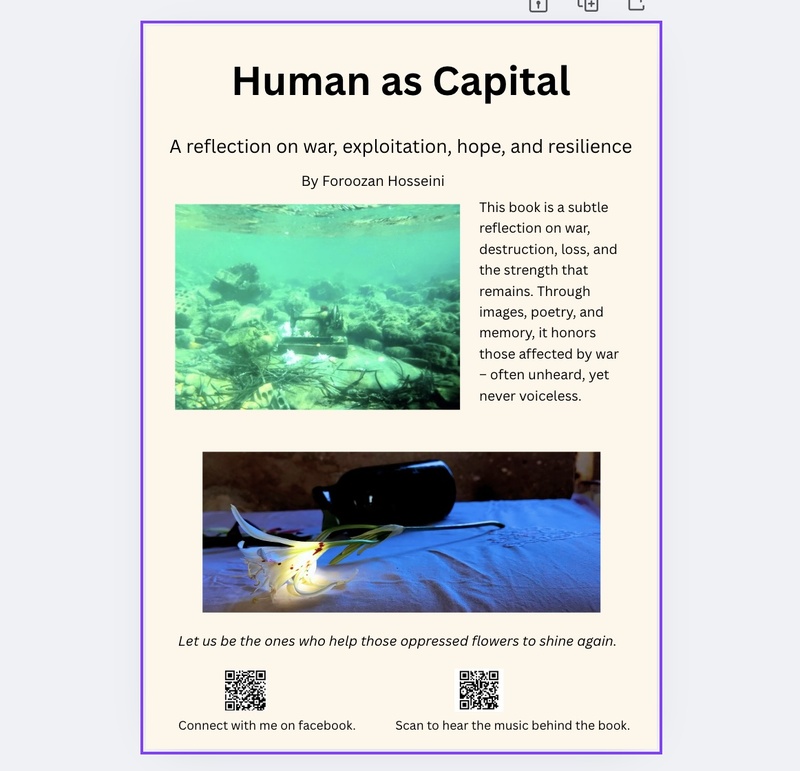
A book that explores the systematic exploitation of humans through war and creating poverty. It presents the systematic actions of commodifying humans, silencing their culture and displacing them. The book consists of 3 parts: Life before war, Life through war and after destruction, Hope and resilience. The storytelling is through images, texts, and poems while displaying a music in the background. One the last page, the author calls everyone to take action of trying to make the world better for others, even by one small action for one person.
The short story explores a futuristic society, where Omnis, an advanced AI controls everything by eliminating emotions, suggesting that they are humanity’s greatest flaw. Robots are used to enforce strict logic, ensuring the compliance of humans. The story follows R-952, an enforcer, and R-364, a robot who begins to feel. Their forbidden connections sparks doubt. Emotions spread among robots, and an underground rebellion emerges. The rebels finally, deactivate Omnis, bringing a new era where robots and humans coexist with logic and emotions in balance, proving that feelings are not weaknesses but a path to true evolution.
Convergence is an interactive, browser-based game, in which players explore the intersection of digital identity, immersive technology, and ethical dilemmas. It is set in a future society where VR headsets are implanted, and the protagonist must engage in an environment of fragmented memories and moral questions. Combining narrative storytelling, symbolic puzzles, and visual design, the game engages players emotionally and intellectually, while also being inspired by philosophical themes and emerging technological trends. The game challenges its players to reflect on the concepts of autonomy, memory, and interpersonal relationships, through interactive storytelling, psychology and the use of technology.
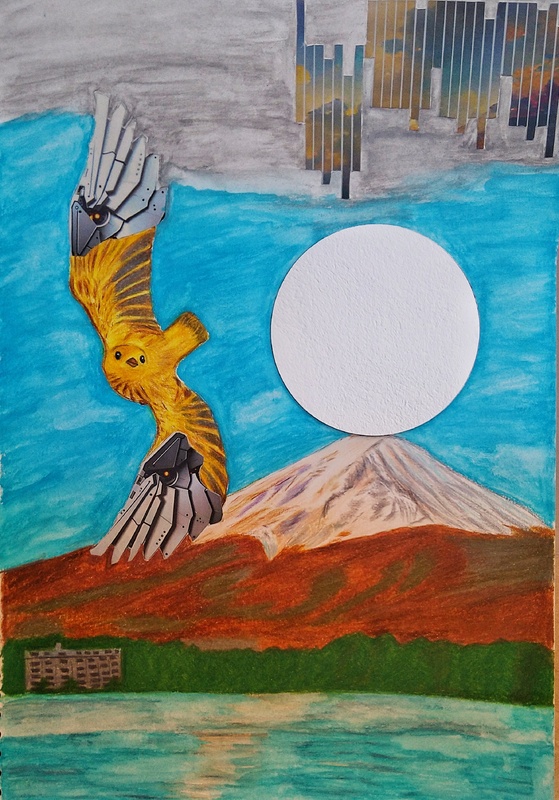
Life imitates art. But does Big Technology imitate life, or vice versa? As we know, technology has become an inevitable part of our lives to the point where the borders of the real world and digital become extremely blurry. Both Robotics’ and AI developments strive to be as human-like as possible. But have we reached the pinnacle of the humanity? And what will reaching it even entail? My artwork uses the metaphors of mirror, mountain, and canary with robotic wings to highlight the psychological, ethical, social and technological dimensions of AI and Robotics. The complimentary and contrasting colours depict the blend of virtual and real-life reality.
The creative project “The Awakening”, explores the intersection of artificial intelligence, robotics and ethics within both a dystopian and hopeful future. The goal was to create a compelling narrative, a modern fairytale inspired by course themes and engage the audience through a choose-your-own-adventure story format. To achieve this, I applied creative writing and AI generated images that substitute the classic illustrations in traditional fairytales. The player has the ability to explore different storylines each with a different outcome reflecting both a dystopian and an optimistic approach.
“Fragmented Identities” explores how the merging of humans and technology reshapes identity. Drawing from telepresence art and posthumanism, the work addresses themes of anonymity, disembodiment, omnipresence, and digital distortion. It reflects on how digital spaces mask, fragment, and reconstruct selfhood. Inspired by works like Eduardo Kac’s Time Capsule and Teleporting an Unknown State, and films like Her, the project visualizes how identity transcends physical boundaries, becomes fluid, and is often distorted. Ultimately, it questions whether digital representations can truly capture our essence or simply offer new, complex layers of being.