For my creative project in the Digital Citizenship course I created a painting called “Lost in the World of IoT”. This painting depicts a woman plummeting in a void of various IoT devices. This composition depicts the notion that gadgets, whose initial aim was to aid us, have fully integrated themselves into our lives – an epitome of a digital ecosystem. The proximity of the devices to the woman bestows a feeling of entrapment while the lack of color on the woman (contrasted with the vivid gadgets) further exasperates the idea of absolute disorientation.
This multimedia painting, “Would You Connect Me Please?”, created for the Digital Citizenship course on Internet Of Things (Iot), uses as a metaphor, cables, wires, CDs, vinyls, wood, sticks, string, and flowers to contrast the crowded chaos of IoT connectivity with the empty calm of the pre‑digital world. It illustrates how real‑time data, automation, and health tracking boost efficiency and problem solving yet threaten attention, memory, mental health, and genuine social interaction. Drawing on research into digital addiction, privacy, and critical thinking, the work challenges viewers to question where convenience ends and intrusion begins, urging us to set boundaries that safeguard autonomy and cognitive well‑being.
Entangled Beings Symbiotic Portraits is a triptych reflecting the complex relationship between humanity and nature. Each piece serves a distinct purpose: one represents the anthropocentric worldview through fragmented facial features. The second celebrates the non-human world, using natural elements and living organisms like wild-type Aspergillus nidulans, a fungus chosen for its visual transformation when genetically altered, to explore nature’s agency and beauty. The central echo-essence piece acts as a point of convergence, where human and non-human elements meet, symbolizing entanglement, mutual transformation, and the blurred boundaries of our shared existence. There is a drawn woman decorated with a flower and the same fungus – genetically modified – who has lost its color due to the “human touch”.
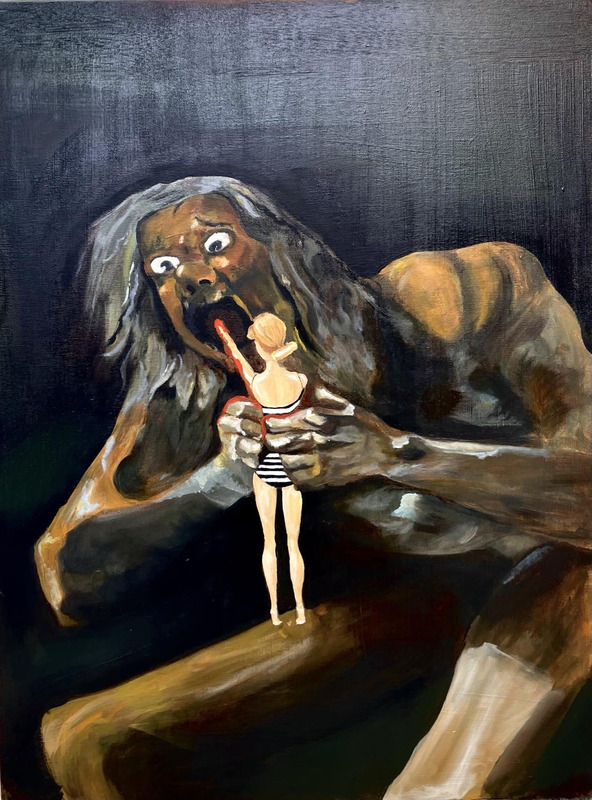
In this work, I worked with the idea of ugliness, in order to create an artwork. I tried to show how time affects what we consider beautiful which in our case is youth and beauty. In my painting I created a barbie figure to symbolize beauty, which is being devoured from a monstrous-looking male. This ugly male figure is a reference to Goya’s painting “Saturn devouring his son” where Saturn, one of the Titans eats his son alive so that he won’t be able to take his place. Here instead of Saturn, we have Chronos, who eats the beauty out of a young woman who also happens to be a universal symbol of femininity.
This painting represents, a sustainable world on the top and a world with global warming, fires, with no care about the environment. The non-sustainable world is reaching for help from the ideal one and the sustainable one is reaching to help the crashed world. This painting wants to portray the urgency for raising awareness about the protection of our environment before it’s too late, while also showcasing with the reaching of the two hands the need to all work together in order to reach our Sustainability Development Goals and make earth a better place.
“Sterile Rot” dissects the internalized and external sexualization of the female body through the lens of the medical gaze. Through a blend of paintings and video the work confronts the uncomfortable romanticization of the female body in pain, in compromising positions, its leakage, raw form juxtaposed to the concreteness and sterility of medical equipment. The body emerges not merely as a vessel of expression, but as a tool itself, challenging viewers to confront the complexities of power dynamics and the commodification of female pain in contemporary society.
Over Rome’s overflowing pathways, this vibrant painting reflects the city’s soul. The Vespa dominates this scene as an emblematic sign of urban movement and Italian style. This is an absolute display of the power of the Vespa on the architectural and cultural landscape of Rome. In my presentation I will explore the transformative role of Vespa, linking it to transportation, lifestyle, and urban aesthetics. As it moves through the city’s streets, it leaves unforgettable tracks that shape Rome’s story and enrich it during every lively trip.
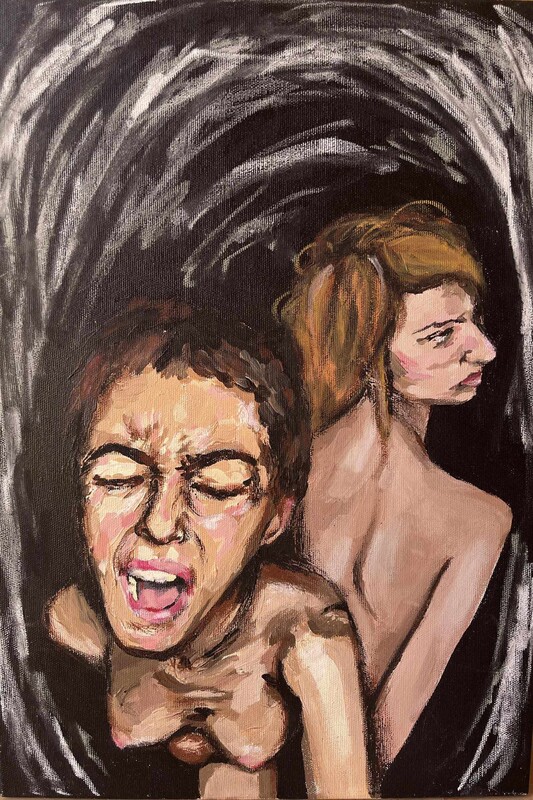
My project is a diptych containing of a 50x35 cm and a 24x18 cm work, made of acrylics, oil pastels and acrylic markers on canvases. In my work, I reflected on the concept of sisterhood, as portrayed in Sophocles’ (441 BC) tragedy Antigone, between Antigone and Ismene. Essentially, the relationship of Antigone and Ismene poses an excellent example of the complexity of sisterly connection, which also interrelates with the notions of motherhood and womanhood. Therefore, I aimed at portraying the intensity of this family dynamic that is represented in Antigone, by employing visual arts practices.