For my creative project in the Digital Citizenship course I created a painting called “Lost in the World of IoT”. This painting depicts a woman plummeting in a void of various IoT devices. This composition depicts the notion that gadgets, whose initial aim was to aid us, have fully integrated themselves into our lives – an epitome of a digital ecosystem. The proximity of the devices to the woman bestows a feeling of entrapment while the lack of color on the woman (contrasted with the vivid gadgets) further exasperates the idea of absolute disorientation.
This multimedia painting, “Would You Connect Me Please?”, created for the Digital Citizenship course on Internet Of Things (Iot), uses as a metaphor, cables, wires, CDs, vinyls, wood, sticks, string, and flowers to contrast the crowded chaos of IoT connectivity with the empty calm of the pre‑digital world. It illustrates how real‑time data, automation, and health tracking boost efficiency and problem solving yet threaten attention, memory, mental health, and genuine social interaction. Drawing on research into digital addiction, privacy, and critical thinking, the work challenges viewers to question where convenience ends and intrusion begins, urging us to set boundaries that safeguard autonomy and cognitive well‑being.
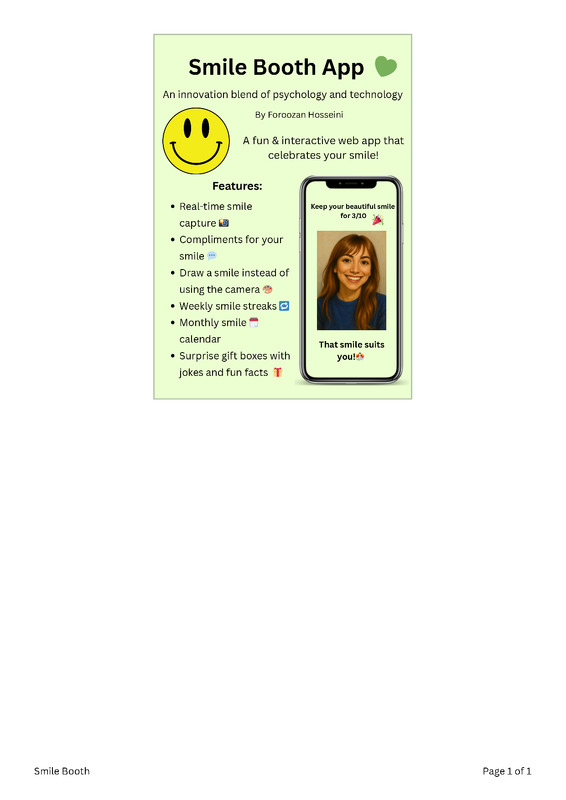
Smile Booth is an application designed to encourage users to smile. It detects the smile of users in real time using AI and counts the smile over 10 seconds; then rewards users for recording their smile. For days that users may not feel using camera, it offers a creative feature to draw a smile and write a positive sentence. Smile Booth also includes a fun page with two giftbox - One relives a joke and the other a fun fact. On the Callander page, it shows the days of the month and the number of smiles that users recorded. It is simple to use, user friendly, and made to spread positivity.
This project is a card game based on cybersecurity. The cards represent different cyberattacks and their role in the game matches their corresponding cyberattack. In total, the game is played with a deck of 15 cards and 8 different roles. The goal of this game is the meaningful and interactive engagement of the players with certain concepts of cybersecurity, specifically the function of various common cyberattacks. The roles are, password attack, antivirus, the worm, ransomware attack, trojan horse, DDoS attack, phishing attack, and sensitive data. The players must utilize these cards to either obtain and keep the sensitive data card until the end of the game, or make their opponents discard it and lose.
This project focuses on building a browser-based online delivery platform for catering businesses, following the practices of similar apps used in our everyday life. It’s designed for desktop users and allows them to browse restaurants and dishes, place orders, and interact with an AI chatbot to help with orders. The platform also supports search, reviews, and IP-based location detection for quick address setup. Users receive personalized recommendations based on their previous orders and general suggestions based on overall ordering trends.
This project, My Screaming – Music to Your Ears, shifts to protest art to expose the brutality of industrial animal farming and challenge anthropocentric hierarchies. Through a soundscape processed in Audacity, familiar farm sounds gradually transform into unsettling, manipulated recordings of slaughterhouses, prompting listeners to reconsider human superiority and animal consciousness. Inspired by Teresa Margolles’ subtle protest art, the audio culminates in a supermarket setting, reflecting society’s desensitization. The project urges listeners to empathize with non-human suffering and reflect on their complicity as consumers in an overconsuming, power-driven world.
This website displays the top rated movies from multiple genres. Registered users can log in to rate, comment on, and add movies to a virtual cart. Guests can browse movies but must register to interact. Logged-in users can also view and edit their profiles. Staff users can add or edit movies, while the owner has full control, including the ability to delete movies.
Entangled Beings Symbiotic Portraits is a triptych reflecting the complex relationship between humanity and nature. Each piece serves a distinct purpose: one represents the anthropocentric worldview through fragmented facial features. The second celebrates the non-human world, using natural elements and living organisms like wild-type Aspergillus nidulans, a fungus chosen for its visual transformation when genetically altered, to explore nature’s agency and beauty. The central echo-essence piece acts as a point of convergence, where human and non-human elements meet, symbolizing entanglement, mutual transformation, and the blurred boundaries of our shared existence. There is a drawn woman decorated with a flower and the same fungus – genetically modified – who has lost its color due to the “human touch”.
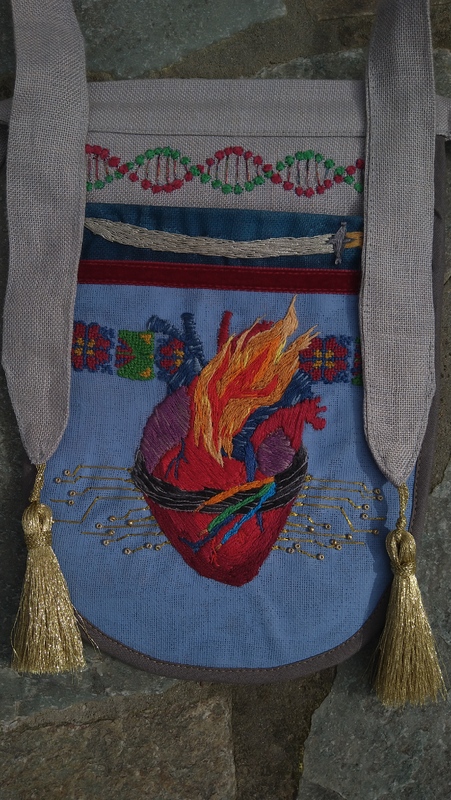
The creative project explores such concepts of the course as Bioart and the beginning of the networked body as shown in the last part of the documentary ‘All Watched Over by Machines of Loving Grace’ by Adam Curtis which implies a commentary on how humanity strives to find answers in math and technology. I used one of the Mitchel’s definitions in which bioart is also an art that does not use biotechnology as a medium but as work that generates a critical debate over biotechnology. My project is dedicated to the topic of AI and biotechnology currently attempting to reshape and re-engineer lives with the current AI technology having a near-religious status of changing the concept of human. The creative output is a Ukrainian traditional outfit’s accessory called ladunka with hand-embroidered reimagined sacred heart, flowers, sword and DNA sequence.
This project seeks to improve our understanding of The American college of Greece's history by examining it through the eyes of the many students who studied here. By looking at it through the lens of the many students who have studied here, this project seeks to show the history of the college in a unique light. While the entire 150-year history was beyond the scope of this project this project still manages to cover the majority of the 19th century from 1920s to the 1990s. Covering each decade in depth through the works, photos and words of ACG students and staff.