Herstory is an art activism movement, built to empower and educate people about females in the world on art and design. Graphic Design has always been a male dominated field, and many female designers have been overshadowed by their male peers and mentors. One such woman is April Greiman, whose name cannot be mentioned without referring to her mentor Wolfgang Weingart. This project is an animation-motion design campaign about Greiman’s style design and history. By following the Design Thinking methodology, the campaign's goal is to capture Greiman’s design, ideology, and history through subtle visual elements.
Comedic video portraying a plague doctor following the same practices in the year 2024. The aim of the video is to show the absurdity of the medieval practices of plague doctors, especially with the common medical and hygienic knowledge the average person has today.
‘It’s vital for me to be able to listen to you, to hear what is it that defines you and for you to listen to me, to hear what is it that defines me’ -Audre Lorde
For my creative project assignment, I took my friend Orestes’ interview. I asked him questions related to the topic of masculinity, and how he navigates his own gender identity. My aim was to illustrate how a contemporary man experiences masculinity in the real world, in his words, by highlighting his personal narratives using a direct interviewing approach.
Showcasing the juxtaposition between Antigone from antiquity and contemporary Antigone, this short film aims to unmask the independence, femininity, promiscuity and power posed by a timeless ‘Antigone.’ This Antigone is one who transcends from her actions and morals and feels liberated, autonomous and jovial. Left to the interpretation of the viewer, this short film that switches from a tragic monologue to a passionate modern Antigone embodied by Patti Smith in the background poses the following question to the viewer: Are we each a different version of Antigone, seeking to escape the norm and achieve our own sense of justice?
It is a video involving two characters (both played by me); a modern antifeminist woman, and a suffragette of the 20th century that has accidentally time traveled and ended up in the antifeminist’s house. After the sudden appearance, there is a brief discussion between the two characters, with the suffragette being elated about the freedom women have gained, and the antifeminist thinking that she is crazy and accusing her of being feminist. The video ends with the suffragette running away, claiming that there are some people she needs to meet (the feminists). It is a sketch meant to highlight the irony of women being antifeminist, and the phenomenon of women taking the freedom they have in this day and age for granted.
The documentary explores the history and legacy of Ballroom culture. It aims to reposition Ballroom culture, moving beyond its stereotypical association with “rebellious” 1980s youth subcultures to its roots in 19th-century Harlem, where it began as a space for the self-expression and empowerment of Black and Latinx groups. Through archival footage and clips from Paris is Burning (1990) and Pose (2018), the film challenges narrow portrayals of marginalization, which often focus solely on struggle, instead emphasizing the joy, creativity, and resilience at the heart of the culture. It invites viewers to see subcultural expression as both a resistance to the mainstream and a celebration of identity.
Having explored the dimensions, ethical limitations and conditions under which poverty is represented through various mediums (literature, photography, videography, documentaries, theater) throughout the course of HHU 2208, my creative project aims to ethically and effectively represent three individuals (trans and non-binary).
The goal of my project was to portray that poverty can, in fact, be ethically represented if certain measures are cautiously applied. Moreover, as these three individuals (and a large plethora of the trans community), are facing a hard time in being able to afford hormones or surgeries, I had also created a fundraiser and encouraged my classmates to donate, reaching the total donation of 245 euros.
Lastly, this project aimed to point out that the financial issues that come with being trans, are not talked about enough; Not being able to cis-pass is life threatening, due to dysphoria as well as due to the anti-trans sentiment that may clock these individuals, leading to discrimination or violence.
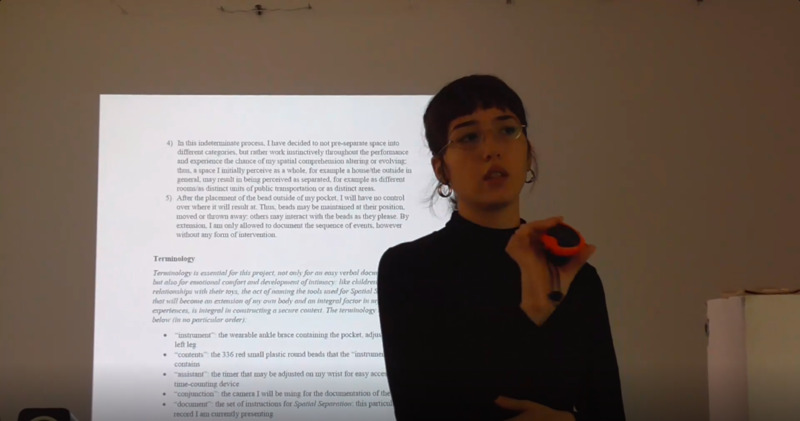
In a process of realization regarding our position within spatial and conceptual frames, Spatial Separation is a performance project that attempts an intimate observation of one’s interaction with their environment. The documented performance involves myself, inserted into a state where I am required to consistently bear a pocket that is stacked with small round plastic beads; during the performance, which lasted fourteen days incessantly, I aimed to experience my daily life normally, with the sole exception that, whenever I stayed in a space for one hour or more, I had to pull one bead out of my pocket and mark my presence.
The project is a comedic video, of me acting as someone who has taken the HHU/HSS 2206, Digital Citizenship course, but has no idea what it is about. I present 3 main topics discussed in the course, but as my character does not understand the contents, he doesn’t explain it well and faces many misfortunes due to it.
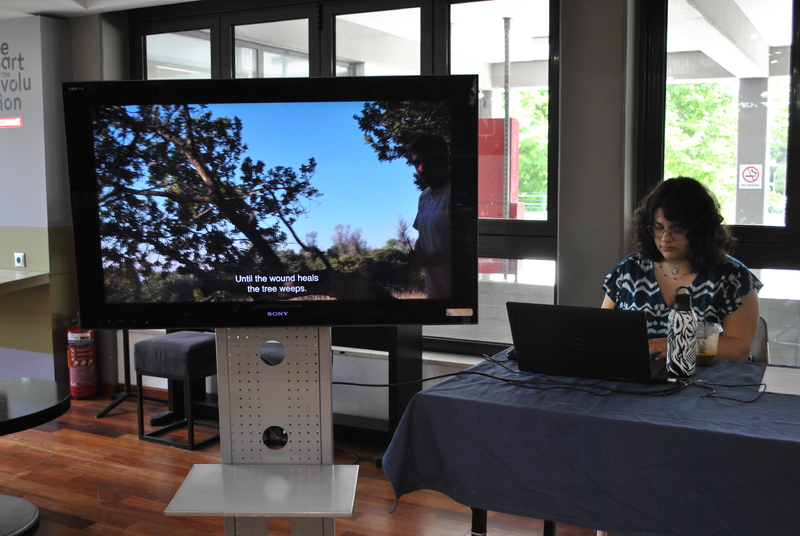
It can be said that no other product is more closely connected to its place of origin than mastiha is to my home, the island of Chios, where Mastic gum, or mastiha, prized for its healing qualities has been defining the island’s history for centuries and is an inseparable part of the island’s identity.
The Tears of Chios investigates the story of Mastiha in shaping the history, traditions, and customs of the island of Chios. Despite regime changes over the centuries, industrialization, technological advances, social and cultural transformations, the production of mastic continues to shape the life of the people of Chios.