The paper (and presentation to be used in the symposium) aims to delve into the fundamentals of the Langlands program and use the Mirror Symmetry that occurs in Modular Forms as the common factor to suggest a potential application to an extension of String Theory, M-Theory. The objective is to examine whether a so called Grand Unified Theory of Mathematics (connecting Number Theory with Harmonic Analysis) can be useful for the theoretical framework of a respective Unified Theory of Physics that combines General Relativity and Quantum Mechanics.
In my artwork, I weave Christian symbolism into every aspect, aiming to evoke a profound spiritual experience. The baptismal bed symbolizes purification, while the illuminated canvases represent the primary colors used in byzantine portraits of saints,
guiding viewers on a journey of faith and self-discovery, inviting them to deepen their connection with the divine or to simply tag along on my journey towards accepting Christ into my life.
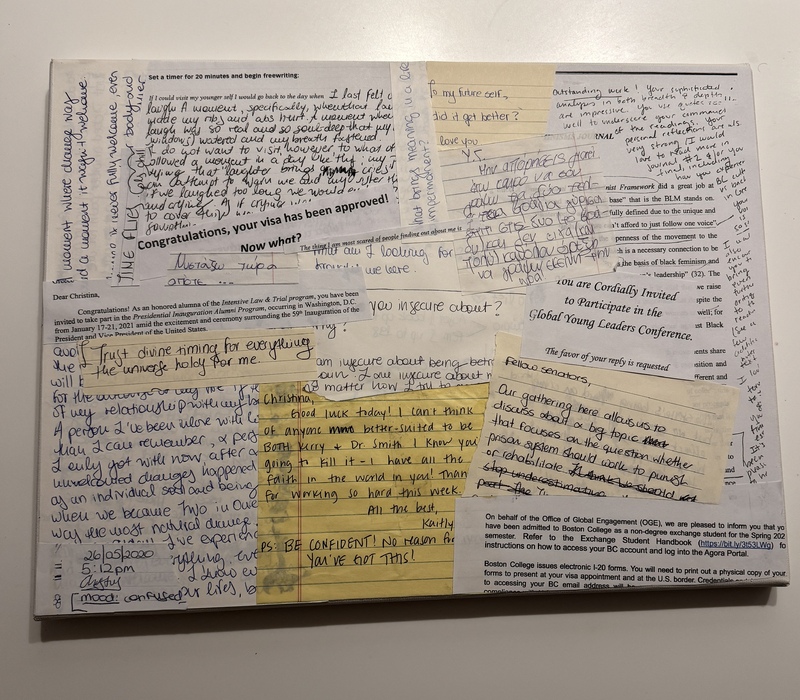
"Self-Portrait of the Mind" is a self-reflective collage project encapsulating the journey of consciousness. Utilizing personal time capsule journaling and symbolism, it distills defining moments from youth to adulthood, portraying shifts in identity and personal growth. While tangible artifacts evoke multi-sensory recollections and deep engagement with memories, the chronological arrangement mirrors the evolution of consciousness, from innocence to self-discovery. Ultimately, the project serves as a dynamic exploration of identity and narrative, driven by the human quest for self-expression and understanding.
It is a short story in the style of Dr. Seuss that explores consciousness and “the hard problem” through a child’s inability to think about what it’s like to be different animals.
The project is a video of interviews conducted on and off campus. The interviews explore different attitudes and beliefs about poverty and the conditions the poor live in. All individuals in the video answer the same set of questions and the audience is able to compare how socioeconomic status, age, and their variables effect ones opinion on poverty.
In a magical world beyond any imagination, where reality and fantasy blur, only a black hole is needed to transport the players into a deep, fantastic world. In a world where every fantastic character comes to life, the clock starts running backwards, which means players need to hurry if they want to explore all the fantastic characters, travel in imaginary plots, narratives, scenarios, and be themselves the version of their favorite character.
“DeMontfort Enigma” is an interactive fiction game, where players explore a mysterious hall and attend midnight lectures. Each player can interact with the environment and characters, while their choices affect the progression. The game is intended for multiple play-throughs to explore all endings, with the first being most important, as it assigns the player a profile showing them statistics about their personal traits. Overall, the project offers an experience in which the player has agency and affects its results. Though this implementation is for entertainment purposes, the engine created can be used in business settings for hiring procedures, among others.
Ideology as a form of enslavement. A means to conceal the truth about society and the system. Brutal scenes of the meat industry as a depiction of the truth that lies behind a distorted, ideological lens.
TRIGGER WARNING
The internet, initially designed to connect people globally, now harbors dark trends where individuals use unconventional means to cause distress for entertainment. Two studies delved into these online behaviors associated with the dark tetrad. The first examined ghosting, revealing correlations with dark triad traits, destiny beliefs, and gender differences. The second explored trolling, strongly linking it to narcissism and gender, particularly noting higher levels in men, and impulsivity was also investigated, with anonymity being a crucial factor in trolling. Combining the findings from both studies sheds light on the complex factors fueling cyber aggression in online spaces.
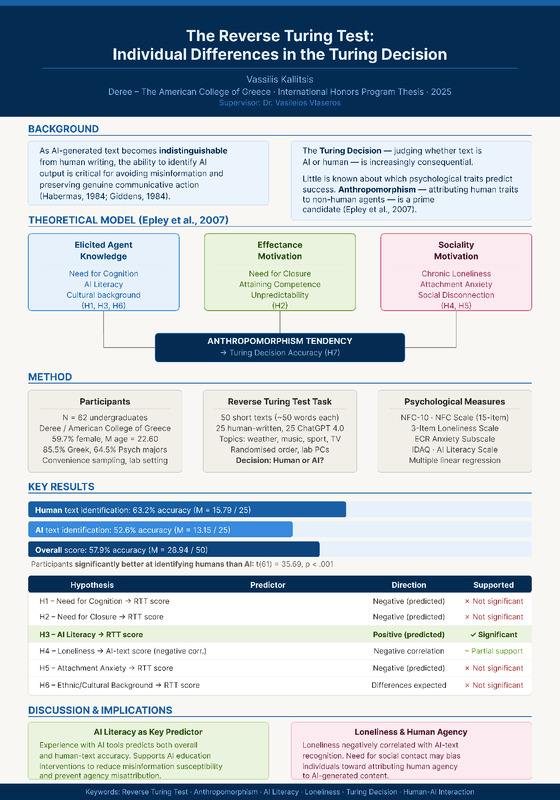
This project is a creative Turing Test inspired by the material discussed during an AI-focused IHP course. The aim of the project was to have our classmates and the professor be the evaluators needed for the Turing Test and try to tell apart which of the presented outputs is AI generated or is created by us and why.