Polyphonic music is one of the most distinctive and ancient musical forms in Europe with Balkans having a very rich tradition of it, especially in rural and mountainous regions. With lyrics created from people based on their everyday life, and orally passed down through generations, Balkan polyphony is a window to Balkans’ history and identity. This project attempts to open this window and allow people to experience this rich tradition of Balkan identity themselves, by interacting with a visual map and watching videos of polyphonic song performances from different places in Balkan countries.
The work explores how human behaviors and rationale risk the overall cybersecurity of an organization, arguing that technological defenses alone are insufficient and the focus should be on the humans and not the technology.
A short diary-entry-style comic about the stereotypical Sad Girl as seen on Tumblr and popularized with Lana Del Rey, with sketches inspired by Sad Girl imagery on Pinterest.
Drawing mainly from Ginsberg's “Howl" and Kerouac's "On The Road", as well as more generalized research regarding what the philosophy of the beat generation was about, I attempted to write a self-reflection that would not only grasp the meaning of their work but also the reflection of their worldview as seen through it. I wanted to imagine how the youth would react to pieces of literature we now find to be groundbreaking for the time, as well as what it truly means to live for a member of that subculture. How you should not get caught up in the joys of materialism but rather enjoy life for what it really is; the connections you make with your own self, nature and the people you love.
This project, Do you feel guilt?, explores the emotional and ethical complexities of representing poverty through a personal and collective lens. Centered on a personal story and hosted on a website inviting others to share their own experiences, the project interrogates guilt, privilege, and authenticity. Rather than offering conclusions, it creates a medium for dialogue, where multiple perspectives coexist. Ultimately, it challenges the idea of representation and shifts focus from speaking for others to listening instead.
Convergence is an interactive, browser-based game, in which players explore the intersection of digital identity, immersive technology, and ethical dilemmas. It is set in a future society where VR headsets are implanted, and the protagonist must engage in an environment of fragmented memories and moral questions. Combining narrative storytelling, symbolic puzzles, and visual design, the game engages players emotionally and intellectually, while also being inspired by philosophical themes and emerging technological trends. The game challenges its players to reflect on the concepts of autonomy, memory, and interpersonal relationships, through interactive storytelling, psychology and the use of technology.
The creative project “The Awakening”, explores the intersection of artificial intelligence, robotics and ethics within both a dystopian and hopeful future. The goal was to create a compelling narrative, a modern fairytale inspired by course themes and engage the audience through a choose-your-own-adventure story format. To achieve this, I applied creative writing and AI generated images that substitute the classic illustrations in traditional fairytales. The player has the ability to explore different storylines each with a different outcome reflecting both a dystopian and an optimistic approach.
The paper (and presentation to be used in the symposium) aims to delve into the fundamentals of the Langlands program and use the Mirror Symmetry that occurs in Modular Forms as the common factor to suggest a potential application to an extension of String Theory, M-Theory. The objective is to examine whether a so called Grand Unified Theory of Mathematics (connecting Number Theory with Harmonic Analysis) can be useful for the theoretical framework of a respective Unified Theory of Physics that combines General Relativity and Quantum Mechanics.
“DeMontfort Enigma” is an interactive fiction game, where players explore a mysterious hall and attend midnight lectures. Each player can interact with the environment and characters, while their choices affect the progression. The game is intended for multiple play-throughs to explore all endings, with the first being most important, as it assigns the player a profile showing them statistics about their personal traits. Overall, the project offers an experience in which the player has agency and affects its results. Though this implementation is for entertainment purposes, the engine created can be used in business settings for hiring procedures, among others.
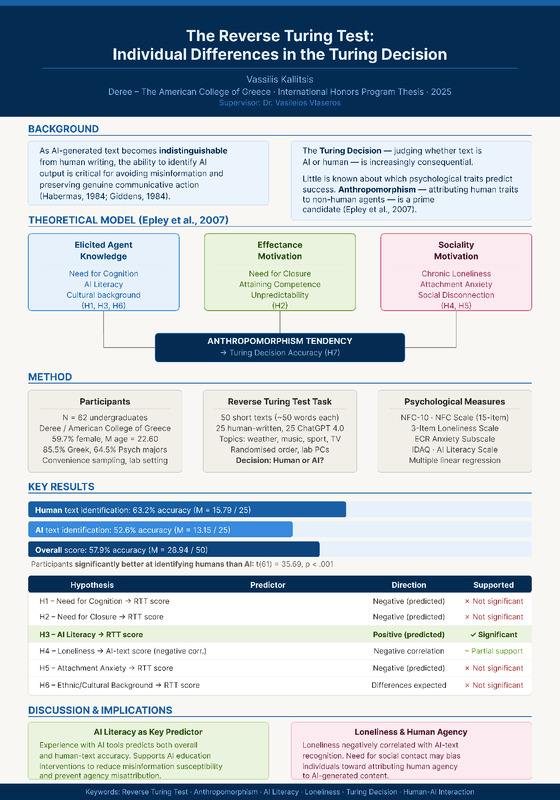
This project is a creative Turing Test inspired by the material discussed during an AI-focused IHP course. The aim of the project was to have our classmates and the professor be the evaluators needed for the Turing Test and try to tell apart which of the presented outputs is AI generated or is created by us and why.