The project “Stuffed with Stigma” is a reimagined board game designed to challenge stereotypes around food and body image. Inspired by neuroscience and psychology related topics around hunger the game transforms the stigmatizing and fatphobic aspects of the original “Pop the Pig” into a learning experience promoting empathy and awareness. Players answer “fact versus fiction” cards which are science driven, confronting common misconceptions about nourishment and weight. Through interactive learning the game encourages more compassionate behavior around eating.
“Fed Up” is a collage on a canvas that explores how food, body image, and emotions are connected, especially under the pressure of social media and beauty standards. The messy, layered look of the artwork reflects the inner chaos many people feel when dealing with eating, self-worth, and how they’re seen by others. Inspired by psychological theories, the piece shows how we can feel torn between who we are and who we think we should be. It is personal, emotional, and it is meant to make viewers think about how society shapes the way we see our bodies, our choices, and our value.
This work touches some sensitive topics, so please discuss with the creator before the project's exhibition.
Aesthetic is a magazine that aims not to follow the stereotypical approaches of magazines that promote unhealthy diets and idealize thinness. The magazine works as guide to a healthy life, which is emphasized through balance. Balancing all the things that we want and we need to do is the perfect combination for a healthy body and healthy mindset. Through this project, readers will be inspired to include a variety of activities in their everyday life, for example trying Pilates to keep their body in movement while trying the new burger house of Athens. The magazine would like to be a safe space for everyone and especially those who struggle with their image and body.
Our project is a photo mosaic depicting the 17 Sustainable Development Goals (SDGs) through pictures. We wanted to showcase not only the individual goals but also the fact that all of the goals are interconnected and are the path that will lead us to a better future. Additionally, we also wanted students to be able to find more information and raise awareness about sustainability and climate change, which is why we added on each image, specific links to environmental speeches, articles, academic journals, and websites.
A board-game that has the basic aim to inform people about the 17 SDGs. You take the role of a representative of your SDG and your goal is to hit the goal before resources run out. Players compete against each other for resources located in the center of play.
This project develops a Sustainable Development Goals (SDG) platform to promote campus sustainability through interactive education. The system features:
1. SDG Awareness Hub – Displays all 17 UN goals with definitions and campus examples.
2. Interactive Quiz – Tests knowledge with SDG-focused questions and tracks scores.
3. Collaborative Blog – Allows students to share sustainability projects (images/videos stored securely via Cloudinary).
4. Admin Dashboard – Manages content moderation and user engagement.
Built with the MERN stack (MongoDB, Express, React, Node.js), the platform bridges theory and action by encouraging student participation in sustainability initiatives.
Impact: Enhances SDG literacy while documenting real-world campus projects.
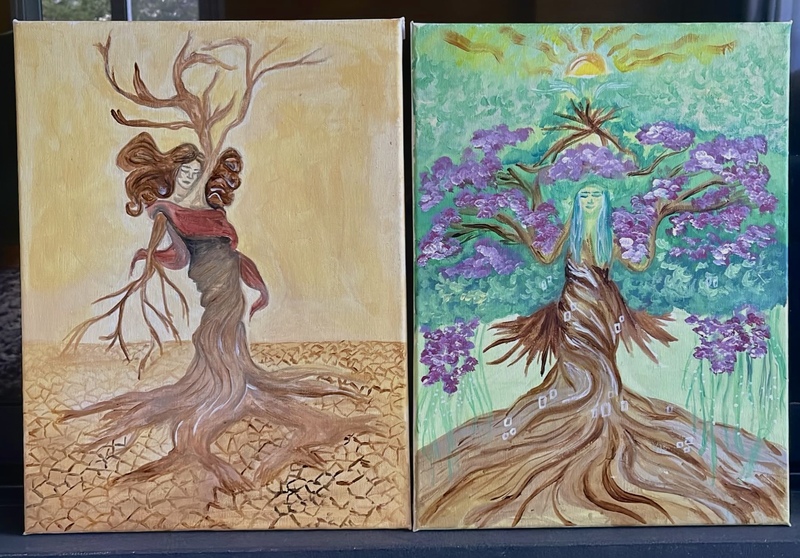
Once upon a near future, we imagined two Earths. One, dry and broken, shaped by our silence. The other, alive and breathing, shaped by our will to act. Between them stands a figure, part human, part tree, holding the tension of choice. Our painting tells this story, not as a warning, but as a possibility. A future still open, still waiting for us to act, either with care or with ignorance, until the “critical deadline”.
Which future will you choose to live in?
A collage of black and white photos depicting portraits of women who managed to break the glass ceiling throughout the decades, accompanied by an explanatory PowerPoint presentation with regards to the concept of glass ceiling.
QR code at the bottom of each photo with a brief story of each woman’s experience in their professional career.
This project is a podcast named “The ministry of Nonsense”. The podcast contains one episode titled “The Economy is Thriving (If You Ignore Reality)” in which two speakers (a Minister and a host) share a “exciting” news to the public. Host’s name is Tweet and Minister’s name is Penny Gone. There are two broader themes: Inflation, which is inspired by Trump’s tariff decision and “Patriot tax” which shapes a promise that never come. Also, the podcast itself served the purpose of revealing the role of media in bureaucracy, while at the same time illustrating a contrast between serious and unserious.
I made a board game, where the objective is to rise through the ranks of power and ultimately “become a dictator”. I based this game on the board game “Snakes and Ladders”, where players roll the die to move along a numbered board, climbing ladders to advance faster and sliding down snakes that set them back. This is the main idea behind my game, except instead of ladders the board had satirical pictures and cartoons of famous dictators and leaders, and “idea lamps”, instead of snakes.