My drawing encapsulates the political aesthetic that characterises the Theban play "Antigone". In a modern courtroom, filled with blinding cameras and people looking for answers, Antigone remains silent, not wanting to provide any explanation to the press of the crime she had committed (which was burying her brother, a traitor of their city). This artwork ultimately presents Antigone's resilience and pride.
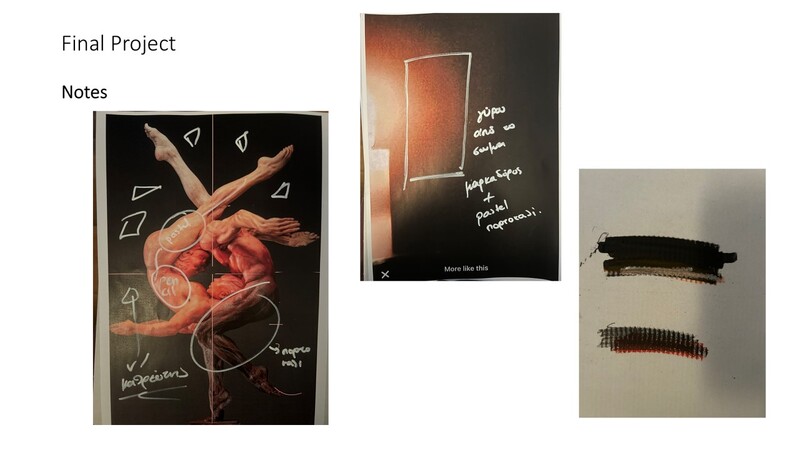
“Grey Area” is inspired by Richard McDonald’s Duality Two Thirds Life (2017). The concept of duality represents a principle that is fundamental to art across all time periods and cultures—it is the timeless paradox that opposites exist in harmony and interdependence with one another. Light and dark, day and night, male and female. These contrasting forces not only coexist but also define one another. Without darkness, we would not understand light; without silence, we would not value sound. Another dominant influence in my project was the contrasts that Marlene Dumas introduces into her art. She often explores oppositions like love and death, beauty and horror, innocence and guilt, or intimacy and violence. Her figures live in that tension.
Based on these, I portrayed a similar composition and introduced different elements to express the theme of duality from my own perspective. I explored the binary of light and dark that exists within each of us, highlighting the constant inner tension between opposing forces. Each spectator becomes a part of the piece through the mirrored surfaces. These reflective elements allow viewers to see themselves, transforming from passive observers to active participants—the protagonists of the work. In this way, the piece becomes personal and introspective. Also, it raises the question of whether there is a “ Grey Area” between ethical and unethical and whatever is hidden in the dark or out accepted by others.
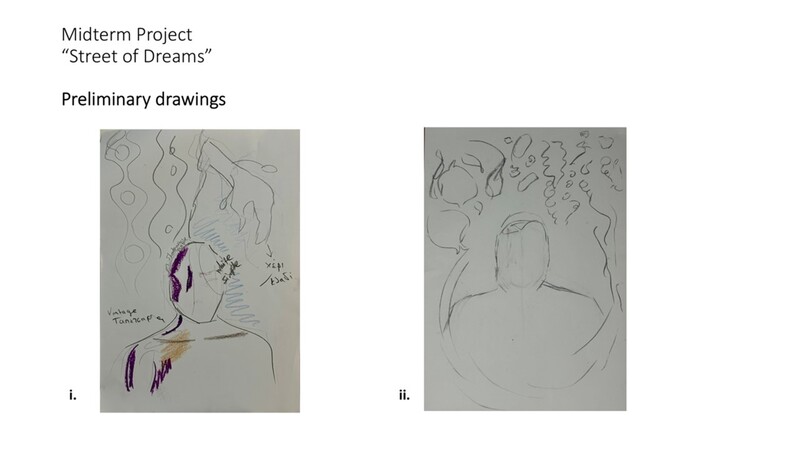
This is a portrait of my Grandfather, surrounded by different kind of fruits representatives of his garden and symbols to our connection and his own life and persona.
I wanted to use color as a temporal element. The subject’s body is colorless underlying the temporality of human flesh. However, the eyes remain colorful and detailed ,conveying “ the mirror to his soul” with all the burdens , the happiness and the nostalgia of an entire life.
The oil branch on the right is the symbol of Crete , where he was born and raised . It is also translated as peace, justice that he achieved after the unfortunate early years of his past . On the other side, the pomegranate tree symbolizes those hardships of war ,neglect and abuse. The rotten fruit seem to "stain" him still .On the top, figs and grapes represent , knowledge and transformation, because he was forced to take the responsibility to “raise himself“ without absorbing the corruption of the abusive years in orphanage.
His garden is located in “Οδός Ονείρων”( ‘Street of dreams’) –he, himself named that street- . And apart for being symbols ,the fruits also highlight our relationship; since I can remember myself ,I was spending my summer days watching him growing his garden and me with love. A simple, grounding love that offered me these mental images to cherish forever.