"Extremist attitudes towards refugees have increased in recent years, a phenomenon strongly
associated to their dehumanization. The literature establishes various predictors of outgroup
dehumanization, often derived from dark personality traits such as narcissism and sadism. This
research aims to further understand the perpetrators of refugee dehumanization, through the
measurement of normative personality traits such as self-esteem and empathy. Moreover,
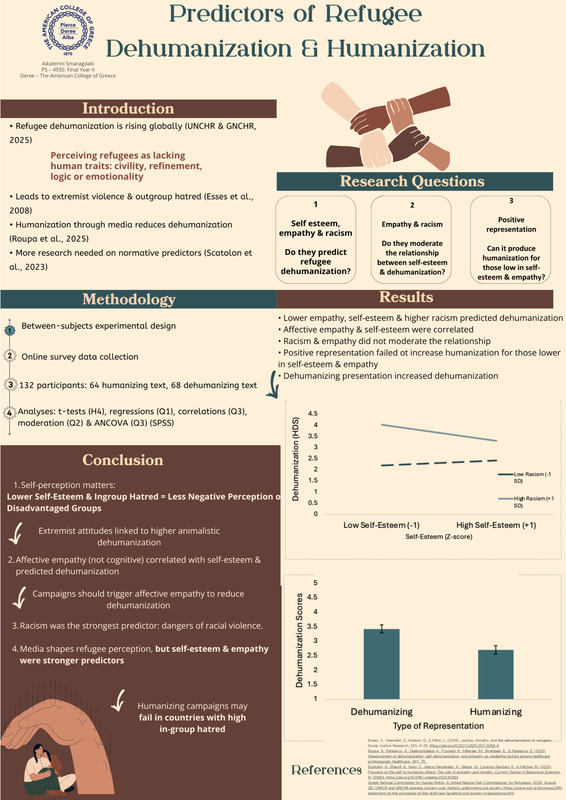
understanding methods of refugee rehumanization was prioritized. To do so, two groups of
participants (N=132) were showcased two contrasting pieces of text that either humanized
(N=64) or dehumanized refugees (N=68). Participants were then measured for their levels of
self-esteem, empathy, refugee dehumanization as well as racism. It was found that all three
variables (self-esteem, empathy, racism) were significant predictors of refugee dehumanization,
with racism being the strongest. A correlation between levels of self-esteem and empathy was
also established. Further analysis showed that racism and empathy did not moderate the
relationship between self-esteem and dehumanization. Lower levels of empathy and self-esteem
were found to reduce the chances of rehumanization of refugees after positive presentation.
Lastly, the text presentation was found to be a strong influence on levels of refugee
dehumanization. These results, offer a greater theoretical understanding of who is more likely to
dehumanize refugees and as a result support extremist action towards them. Furthermore, an in
depth understanding of how refugee presentation can facilitate their dehumanization has been
offered. "