My grandmother's uninhabited abandoned house, in which present time no longer exists and which will soon be sold, becomes the mark of an existence to which all connection has been lost. I return as a future materiality, a ghost which haunts my self—whom I meet there and who does not recognize me: the future and the past, in a constant state of conflict, producing the present self. In the self-portraits that occur from this interaction, all depiction of current characteristics is resisted, constituted through that which has passed and that which is anticipated; in a place between being and not being, life and death. An elusive persona emerges that does not mourn the dead, but rather its own state of being and forgetting.
A deafening dissonance between the body’s essence and that which it performs. A question about what constitutes me: that which I am or that which I do? The solo performance “[Untitled]: Plate Dance, Solo” is constituted by a formalist ritual that traverses through the denouncements that have shaped a rejected body. It performs the failure of gender(ed) performance, it dances shattered identity structures. All through plates; through the domestic, through the traditional, through the conventional: marking a Western history of bodies that have been forcefully made light and quiet, experts on navigating a foreign world, a world whose order and power can crack at any moment.
Environmentalists regard quarries as open wounds, calling for their restoration. However, to close a wound of this scale is totally unachievable. The site-specific durational performance “Notes on Recovery: Reorganization, Restoration, Cicatrization” connects human dwelling with exploitive catastrophe. Performed in one of Mt. Penteli’s abandoned quarries, it invited the audience to attend a ritual that spanned across gigantic hills of rubble, intertwining body and landscape. The body and the site, both in a state of aporia, reflect on each other’s unhealable wounds, merging their respective grief into a singular lament. For any kind of violent enormity, for any huge and impactful event, there will never be any ready means of adequately addressing it. Insufficiency is perpetual and fatal in the face of atrocity.
The concepts of absence can be found in the very fabric of theatre, performance, and visual art in the crossroads between these genres. Absence is between the concepts that shape our view of the world. Exploring Presence in Absence”, was to take a deeper dive in the concept of being present in an absent state of mind. The ideology of “zoning out” intrigued me, it always was a universal phenomenon. No matter where you are from you have access to that space in your mind, yet that space gets shaped and inspired by time, culture, and personality. In this performance I tried to showcase the space that was moulded in my mind.
As the world burns, four people at a dead-end destroy each other, attempting to fulfill a void, futile and self-indulgent vision of happiness. In an ironic image of entrapment and distress, an inherited normative vision of humanity, we oscillate between the raw and macabre, the comic and the absurd. The Theatre Arts Department Senior Production Practicum employs this text by British playwright Ryan Craig to discuss a sense of doom, as the personal mirrors the political, the individual the collective. The characters exhaust their lives, anticipating meaning to occur, desperately afraid of the meaningless.
A site-specific videotaped performance dedicated to the act of displacement: With a few to almost no personal items and parents displaced from Pontus, he was born in Garefi, moved to Aridaia and then was forced to move alone in many different “playgrounds”, with his final destination to be Athens. He had nothing but valuable memories.
From the island of Chios to Constantinople, with the goal of creating a beautiful life, they were forced to flee to Athens together forever and pack their lives in a suitcase. How can you create a new life from scratch after you have been displaced?
The sea can bring us together and part us away, at the same time. Three displaced people taught me to love the sea no matter what, and not be afraid of it. I grew up with them storytelling their lives to me, and it is my turn to tell their story…
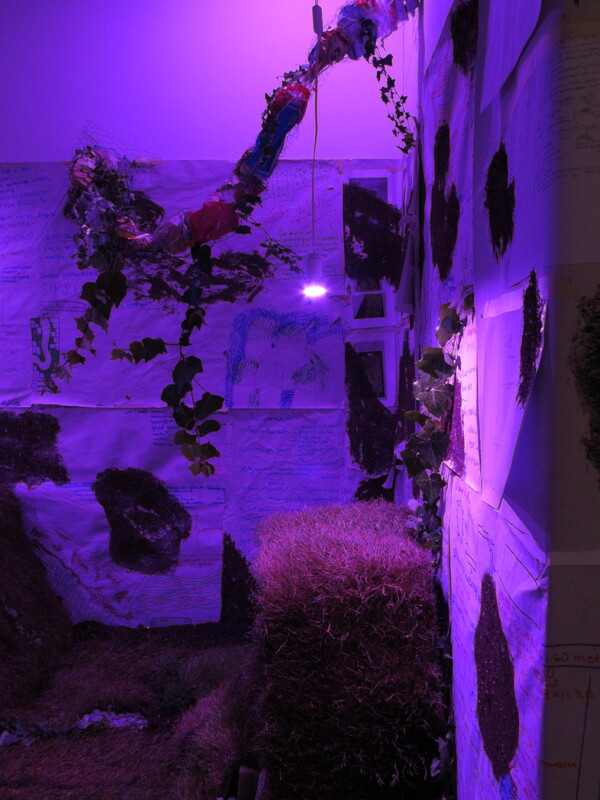
"Environ" provokes a conversation between the naturoid, the gallery space and the viewer. Allowing the audience to start asking questions about the installation itself, and its placement within the gallery. A naturoid is a combination of technology and nature, and with this combination, we have the emergence of new structures and processes. In "Environ", emphasis is placed on the interaction of natural processes and the man-made elements in today’s world, demonstrating our approach towards the environment.
"Environ" consists of natural and artificial structures. The use of natural material refers us to the imperfect patterns of the natural world, while artificial comments on the accurate and industrially made technological materials. The use of these materials highlights the difference and the dynamic of these two worlds. The human impact, the choices we make about the materials we use and insert in our lives, build the world that surrounds us. Our everyday use of technology, either consciously or unconsciously, affects our view of our surroundings. The details that we pay attention to and the things that we ignore.