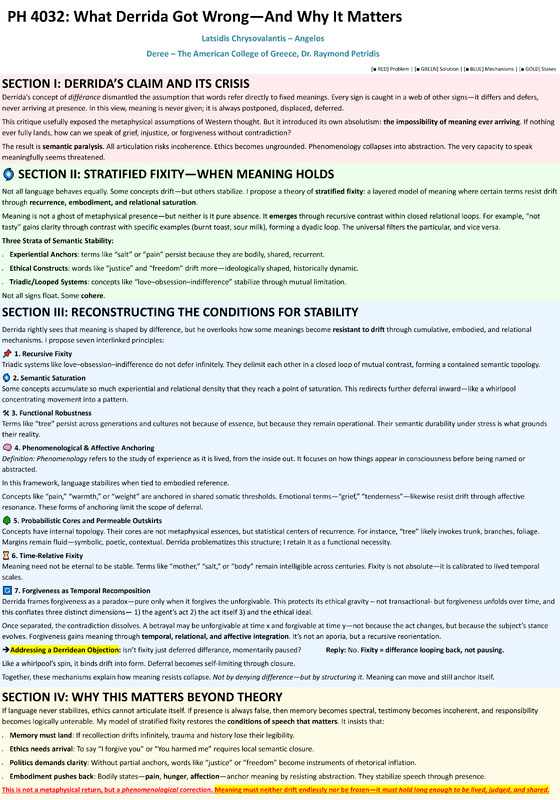
This essay critically revisits Jacques Derrida’s deconstruction of structuralism and binary thinking, arguing that he overstates the instability of definitional cores. Through engagement with critics such as Saussure, Searle, and Habermas, the paper proposes a "centers and outskirts" model that reconciles Derrida’s insights on relationality with the pragmatic need for stable meaning. Additionally, it challenges Derrida’s framing of aporias, like forgiveness, as unsolvable paradoxes by exposing their reliance on extreme abstraction rather than lived experience. Ultimately, the essay seeks a more nuanced synthesis of play, stability, and the conditions of meaning necessary for coherent moral and linguistic life.
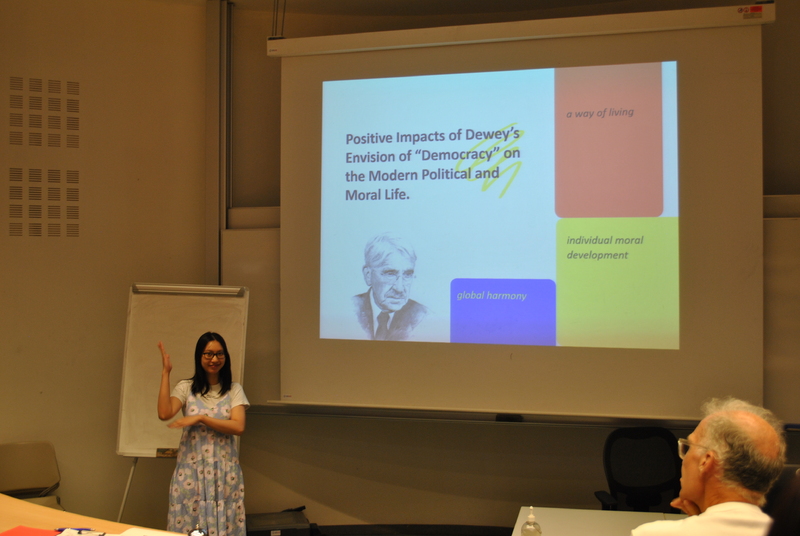
This paper explores John Dewey’s vision of democracy and analyzes its applications in today’s world. As a pragmatist, Dewey employed a problem-oriented approach to social affairs, hence “democracy as a cooperative experiment”. His ideas to be discussed are the theory of inquiry, the notion of growth, and democracy as a way of living. Modern readings have attempted to revive his ideas for possible desirable effects on political affairs and individual self-development in this globalized world. I shall argue how the critical stance central to Dewey’s philosophy is useful in rethinking modern social ills and fostering global harmony amongst diverse groups.
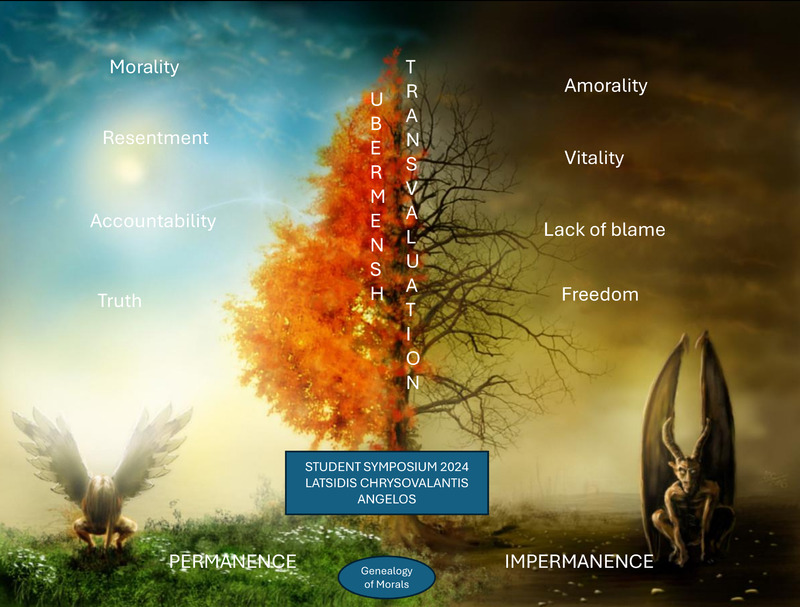
Nietzsche dwells on the origins of bad and good: they were not always used morally but simply as descriptors of reality. How did morals came about? The belief that people have free will is to blame so that the weak can hold the strong accountable behind their resentment. Good became evil. Strength, and enacting our will however provides vitality, which is the Nietzschean essence of life. But is this convincing?