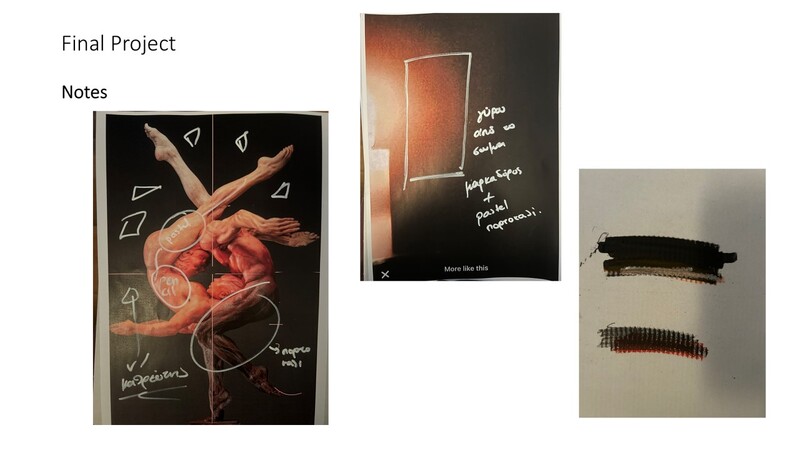
“Grey Area” is inspired by Richard McDonald’s Duality Two Thirds Life (2017). The concept of duality represents a principle that is fundamental to art across all time periods and cultures—it is the timeless paradox that opposites exist in harmony and interdependence with one another. Light and dark, day and night, male and female. These contrasting forces not only coexist but also define one another. Without darkness, we would not understand light; without silence, we would not value sound. Another dominant influence in my project was the contrasts that Marlene Dumas introduces into her art. She often explores oppositions like love and death, beauty and horror, innocence and guilt, or intimacy and violence. Her figures live in that tension.
Based on these, I portrayed a similar composition and introduced different elements to express the theme of duality from my own perspective. I explored the binary of light and dark that exists within each of us, highlighting the constant inner tension between opposing forces. Each spectator becomes a part of the piece through the mirrored surfaces. These reflective elements allow viewers to see themselves, transforming from passive observers to active participants—the protagonists of the work. In this way, the piece becomes personal and introspective. Also, it raises the question of whether there is a “ Grey Area” between ethical and unethical and whatever is hidden in the dark or out accepted by others.
GD 4747 Branding Ecosystems:
To commemorate the 150-year anniversary of The American College of Greece, this branding project explores the creation of a flexible identity system and key visual campaign. The work incorporates historical research, design thinking methodology, and archival materials to craft a unifying visual language. The final outcome includes logo, posters, brochure, and digital assets that reflect ACG’s educational and cultural legacy. Designed to engage donors and the broader community, the project balances historical depth with contemporary communication needs, conveying ACG’s enduring role as a trusted, pioneering institution in Greek education.
Luxury branding shapes fashion, society, and identity by symbolizing status, exclusivity, and aspiration. My essay explores key principles like heritage, craftsmanship, and personalized experiences, alongside theories such as Veblen’s conspicuous consumption and Maslow’s hierarchy of needs. It examines fashion as a social signifier and self-expression tool, analyzing how luxury brands influence self-perception and societal structures. A case study on Chanel highlights luxury's role in social stratification and cultural identity. Psychological aspects, peer influence, and digital shifts further emphasize how luxury branding impacts modern consumer behavior and evolving societal norms.
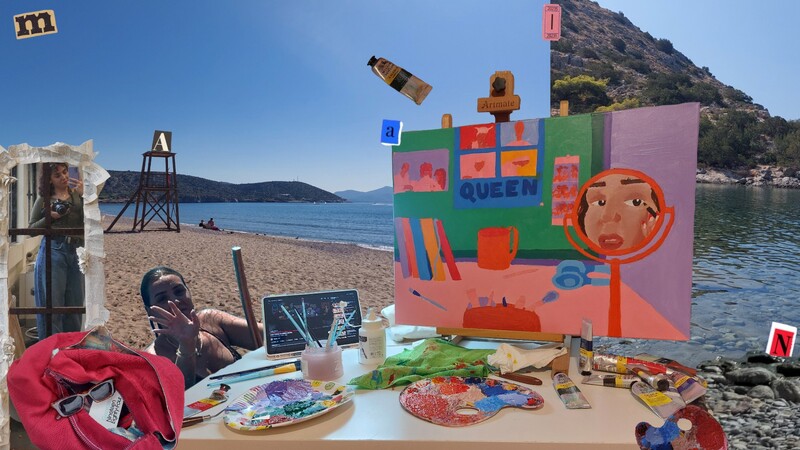
The work submitted was created as a final project in the Painting course (Prof. Effie Halivopoulou) and is meant to emulate my personality, through creating a painted collage. The main goal of this work was to combine physical places in which I feel most creative -the beach and my desk- along with incorporating relevant elements, such as brushes, palettes, and my beach bag. I consciously chose to keep the visual elements of the work flat and reminiscent of cartoons and comic books, inspired by many artists such as Matisse and Lichtenstein, instead of opting for a photorealistic approach.
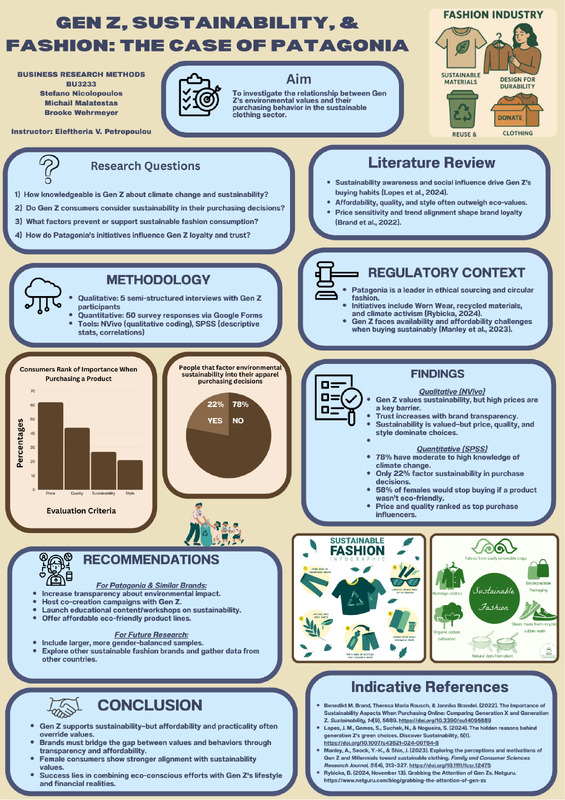
This study explores how Patagonia's sustainability initiatives influence Generation Z's consumer behavior. Using a mixed-methods approach combining surveys and interviews, the research examines Gen Z's environmental awareness, purchasing priorities, and perceptions of Patagonia's eco-friendly practices. Findings reveal a gap between Gen Z's sustainable values and actual purchasing decisions with affordability and quality outweighing environmental concerts. Females showed greater sensitivity to sustainability initiatives than males. The study concludes that while Gen Z appreciates Patagonia's efforts, greater transparency, affordability and tangible proof of impact are essential to strengthen engagement and loyalty among this key consumer group.
My grandmother's uninhabited abandoned house, in which present time no longer exists and which will soon be sold, becomes the mark of an existence to which all connection has been lost. I return as a future materiality, a ghost which haunts my self—whom I meet there and who does not recognize me: the future and the past, in a constant state of conflict, producing the present self. In the self-portraits that occur from this interaction, all depiction of current characteristics is resisted, constituted through that which has passed and that which is anticipated; in a place between being and not being, life and death. An elusive persona emerges that does not mourn the dead, but rather its own state of being and forgetting.
A deafening dissonance between the body’s essence and that which it performs. A question about what constitutes me: that which I am or that which I do? The solo performance “[Untitled]: Plate Dance, Solo” is constituted by a formalist ritual that traverses through the denouncements that have shaped a rejected body. It performs the failure of gender(ed) performance, it dances shattered identity structures. All through plates; through the domestic, through the traditional, through the conventional: marking a Western history of bodies that have been forcefully made light and quiet, experts on navigating a foreign world, a world whose order and power can crack at any moment.
Environmentalists regard quarries as open wounds, calling for their restoration. However, to close a wound of this scale is totally unachievable. The site-specific durational performance “Notes on Recovery: Reorganization, Restoration, Cicatrization” connects human dwelling with exploitive catastrophe. Performed in one of Mt. Penteli’s abandoned quarries, it invited the audience to attend a ritual that spanned across gigantic hills of rubble, intertwining body and landscape. The body and the site, both in a state of aporia, reflect on each other’s unhealable wounds, merging their respective grief into a singular lament. For any kind of violent enormity, for any huge and impactful event, there will never be any ready means of adequately addressing it. Insufficiency is perpetual and fatal in the face of atrocity.
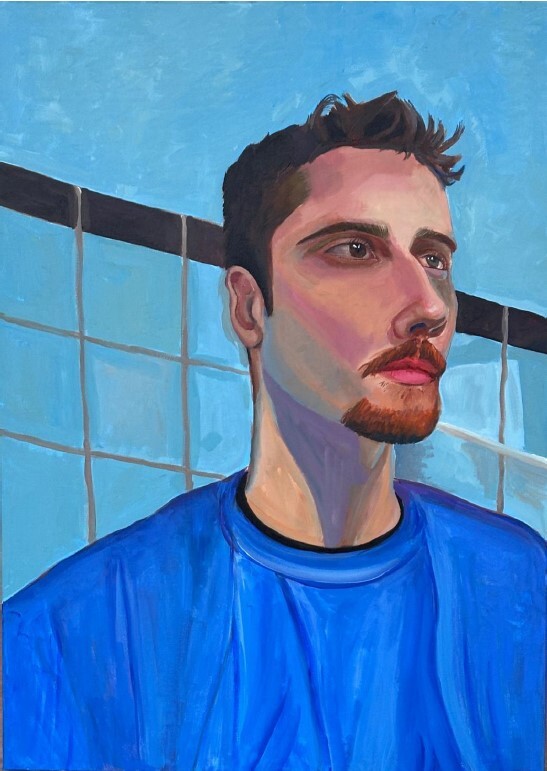
I began with a cool-toned blue underpainting to break from my usual warm palette, aiming for brighter colors. Using burnt sienna, I sketched the figure and built layers, mixing skin tones directly on canvas with wet-on-wet techniques. I painted the background and clothing in multiple coats, experimenting with ultramarine and violet for depth. I used black pigment for the first time in years, which felt liberating. Inspired by Alice Neel and Alpay Efe, I exaggerated facial features and layered tonal values. This painting helped me grow, combining familiar methods with new techniques and boosting my confidence with a new color palette.
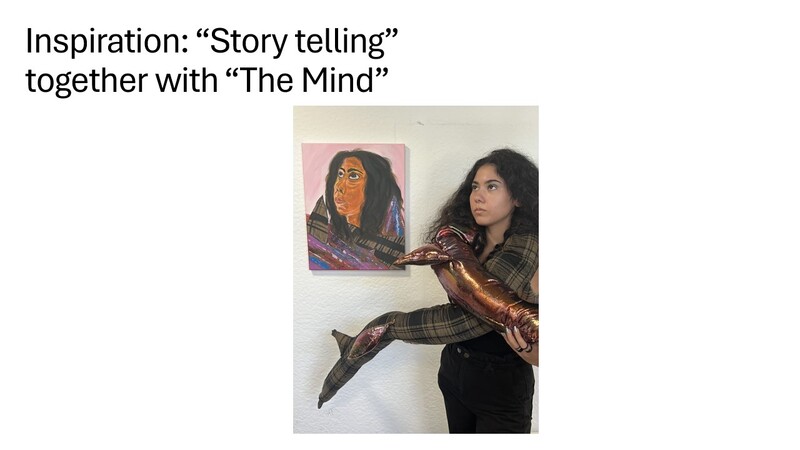
This is a self portrait in acrylic paints. It shows a close-up of my face, the face of the artist, looking up, optimistically but also melancholically. The picture is surrounded and even choked in a way, by a past work of mine, “The Mind”, which is a soft, wearable sculpture. The result portrays my suppressed feelings, desires and fears.