The emergence of artificial intelligence (AI) technology represents a significant breakthrough in the field of medicine. Advanced AI tools such as Convolutional Neural Networks (CNNs) and Generative Adversarial Networks (GANs) enhance diagnostic accuracy, accelerate disease detection, and enable personalized treatment plans. In clinical settings, AI streamlines workflows by automating repetitive tasks, thus allowing healthcare professionals the freedom to focus on patient care. Given the novelty of these models, experts consider the possible challenges in their widespread use, such as AI bias, data availability, interpretability, explainability, patient privacy, as well as external validation and regulatory limitations.
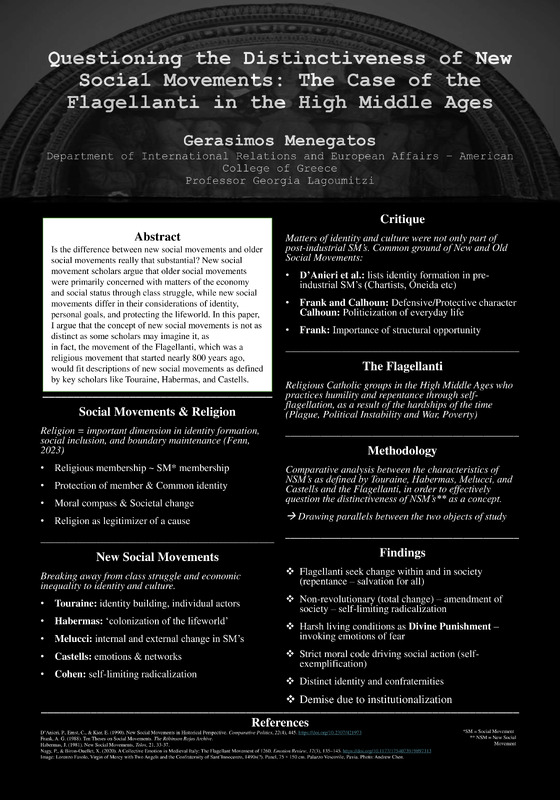
Is the difference between new social movements and older social movements really that substantial? New social movement scholars argue that older social movements were primarily concerned with matters of the economy and social status through class struggle, while new social movements differ in their considerations of identity, personal goals, and protecting the lifeworld. In this paper, I argue that the concept of new social movements is not as distinct as some scholars may imagine it, as in fact the movement of the Flagellanti, which was a religious movement that started nearly 800 years ago, would fit descriptions of new social movements as defined by key scholars like Touraine, Habermas, and Castells.
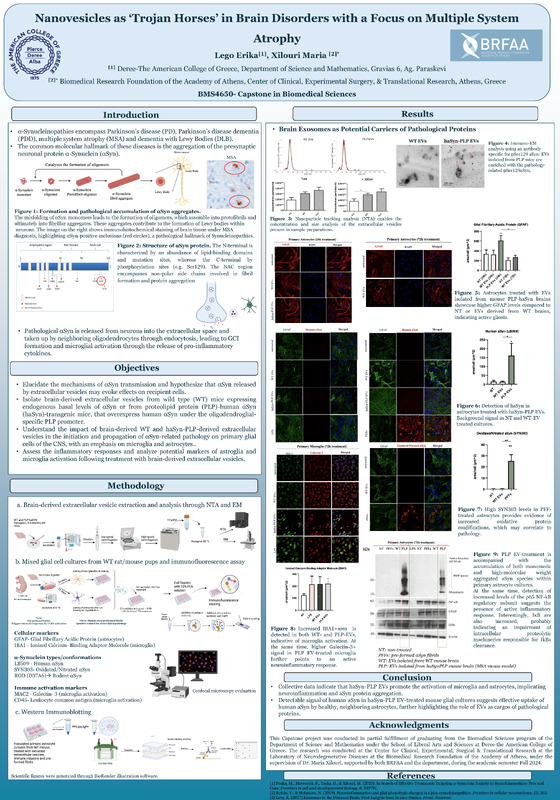
Neurodegenerative disorders along with cardiovascular diseases and cancer are the leading causes of morbidity worldwide characterized by a number of motor and non-motor dysfunctions. α-Synucleinopathies such as Parkinson’s disease (PD), dementia with Lewy bodies (DLB), and Multiple System Atrophy (MSA) are linked to misfolding and aggregation of α-Synuclein (αSyn), a neuronal protein involved in synaptic communication. While PD and DLB feature αSyn aggregates in neurons, MSA is marked by αSyn accumulation in oligodendrocytes. Aggregated αSyn can propagate between cells in a prion-like manner, triggering neuroinflammation and degeneration. Exosomes, small extracellular vesicles released by neurons and glial cells, play a role in spreading αSyn pathology but also hold promise as therapeutic tools. This laboratory-based study investigates the role of brain-derived wild-type and PLP-human αSyn exosomes in MSA, focusing on their impact on neuroinflammation and protein aggregation, and explores their dual role as scavengers and transmitters of pathology and as potential therapeutic agents.
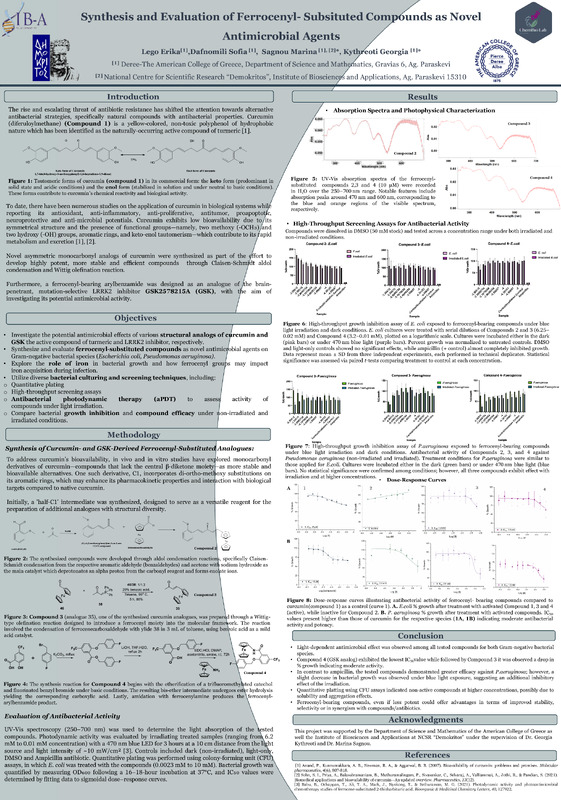
The rise and escalating threat of antibiotic resistance has shifted the attention towards alternative antibacterial strategies, specifically natural compounds with antibacterial properties. Curcumin (diferuloylmethane) is a yellow-colored, non-toxic polyphenol of hydrophobic nature which has been identified as the active compound of turmeric. Curcumin’s antioxidant and anti-inflammatory properties are well-studied, but its poor absorption and rapid metabolism limit its bioavailability. This project aims to examine the potential effects of different structural analogs of curcumin, the active compound of turmeric. Specifically, various curcuminoid derivatives bearing ferrocenyl groups were synthesized and evaluated for their antimicrobial potential. This approach is based on the pivotal role of iron in bacterial growth and proliferation, as bacteria rely on iron scavenged from their environment to survive during an infection when the host limits iron availability to suppress pathogen proliferation. These analogs were tested against Gram-positive and Gram-negative bacteria Escherichia coli, Staphylococcus aureus, and Pseudomonas aeruginosa. Bacterial culturing methods included quantitative plating, high-throughput screening assays, and antibacterial photodynamic therapy (aPDT) to evaluate growth inhibition and compound activity under light irradiation.
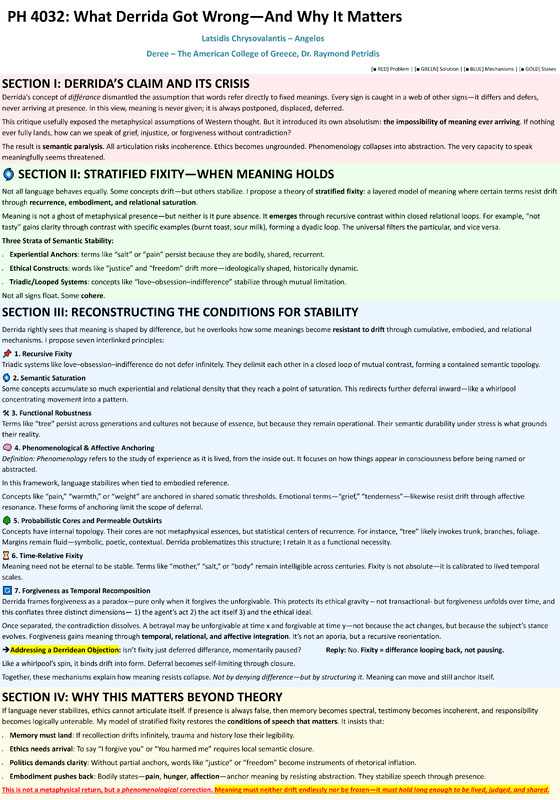
This essay critically revisits Jacques Derrida’s deconstruction of structuralism and binary thinking, arguing that he overstates the instability of definitional cores. Through engagement with critics such as Saussure, Searle, and Habermas, the paper proposes a "centers and outskirts" model that reconciles Derrida’s insights on relationality with the pragmatic need for stable meaning. Additionally, it challenges Derrida’s framing of aporias, like forgiveness, as unsolvable paradoxes by exposing their reliance on extreme abstraction rather than lived experience. Ultimately, the essay seeks a more nuanced synthesis of play, stability, and the conditions of meaning necessary for coherent moral and linguistic life.
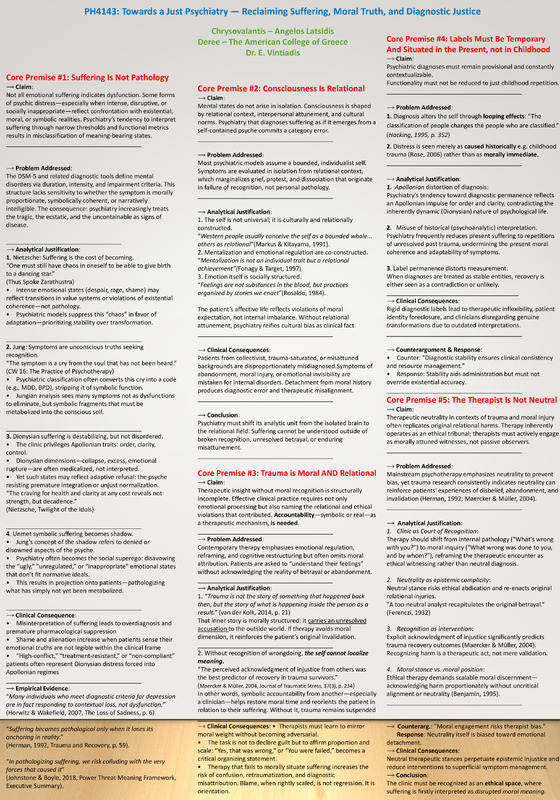
This treatise confronts the foundations of modern psychiatry, arguing that its pursuit of normalization has severed suffering from its existential, relational, and ethical contexts. Drawing on existential philosophy (Heidegger, Levinas, Camus), psychiatric critique (Bracken, Cooper), and trauma studies (van der Kolk), it demands a re-founding of psychiatry not on optimization, but on tragic solidarity. Rejecting both pathological romanticism and mechanical symptom-management, the work envisions a psychiatry that sustains fracture without erasing it, honors relational wounding, and redefines healing as the courageous accompaniment of irreparable lives. Psychiatry must cease diagnosing malfunction and become a faithful witness to human brokenness.
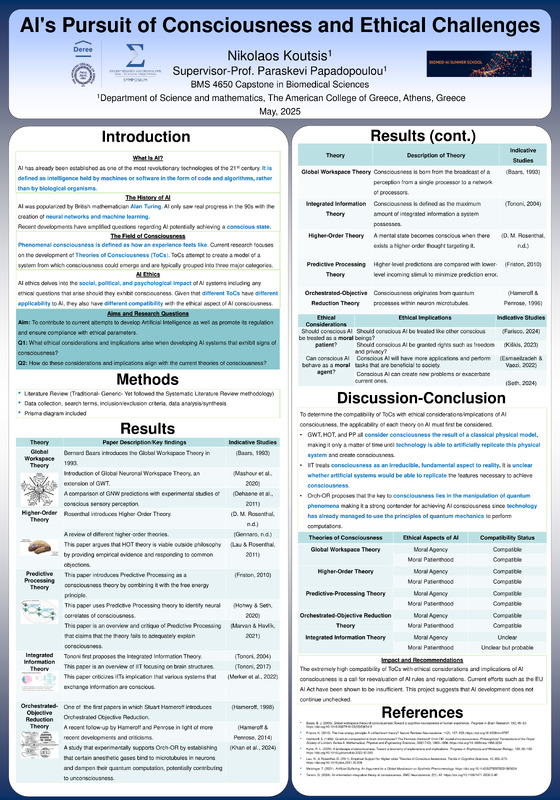
The work presented will be a poster presentation of my capstone project. The paper was a literature review on the nature of consciousness, AI, and the ethics surrounding it. Five prominent theories of consciousness were reviewed and their applicability to AI was assessed. The ethical considerations and implications of AI consciousness were addressed and their compatibility with each theory of consciousness was determined. Findings of high levels of both applicability and compatibility lead to the proposal of increased regulations on AI development to ensure compliance with moral constraints.
Voltage-gated sodium channels (Nav) are crucial for neuronal excitability and action potential propagation. This study integrates X-ray crystallography, AlphaFold 3 predictions,
cryo-EM, and ligand interaction studies to analyze the generic Nav structure and function. AlphaFold 3 predicts key regions,
cryo-EM captures dynamic states, and X-ray crystallography provides atomic-level resolution. Ligand studies reveal modulation by toxins and drugs. Comparing these methods highlights their strengths in resolving structural dynamics. Integrating computational modeling, experimental validation,
and ligand studies enhances neurobiology education by bridging theoretical concepts with practical applications in protein structure-function analysis.
Authors: Athanasios Koranis, Eirini Tzermpou, Sofia Orfanou, Paraskevi
Papadopoulou
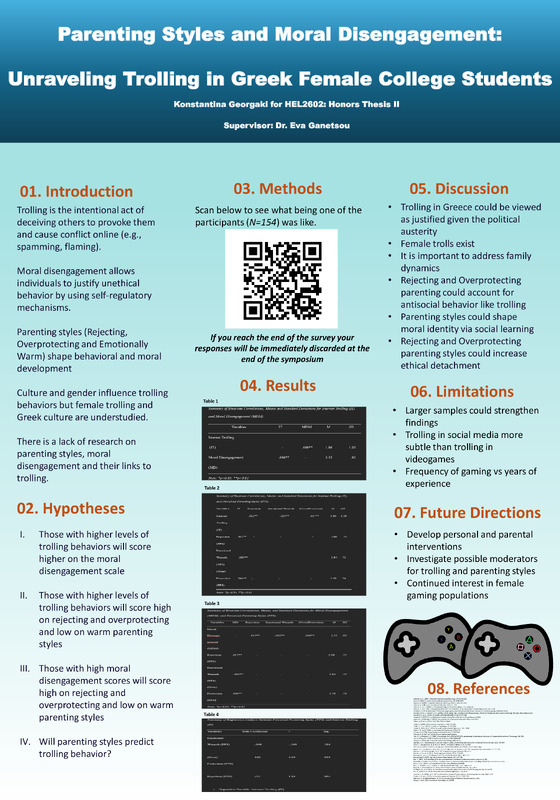
This thesis examined the relationship between moral disengagement, parenting styles and trolling behavior in Greek female college students (N=154), testing whether parenting styles could predict trolling. Participants completed the GAIT, MDM, and (s)-EMBU scales. Trolling was positively correlated with moral disengagement, rejection, and overprotection and negatively correlated with warm parenting styles. Moral disengagement showed similar correlations, and parenting styles weakly predicted trolling. Findings suggest a link between trolling, moral disengagement and parenting styles, contributing to existing literature. Some limitations include time constraints and sample size. Future research can work on developing interventions and exploring moderators between trolling and parenting styles.