My creative project is an audio piece where I play a Brazilian rhythm using kitchen equipment. As a music major, my aim for this project was to incorporate my love for music into the course subject and make it into something fun. I drew inspiration for this project from Prof. Amarildo Costa, whom I had the chance to meet while studying abroad. He was the leader of the Brazilian Percussion ensemble, and he would always tell us in class that his passion for percussion burned so bright that when he was little, he would use pots and spoons in his house to try to make music.
In this short graphic novel, I present how a woman in the 50s makes the most out of her role as a housewife. With this project I highlight how women might have strived for personal agency through their role in the house and as mothers, at a time when opportunities to speak their mind were rather limited.
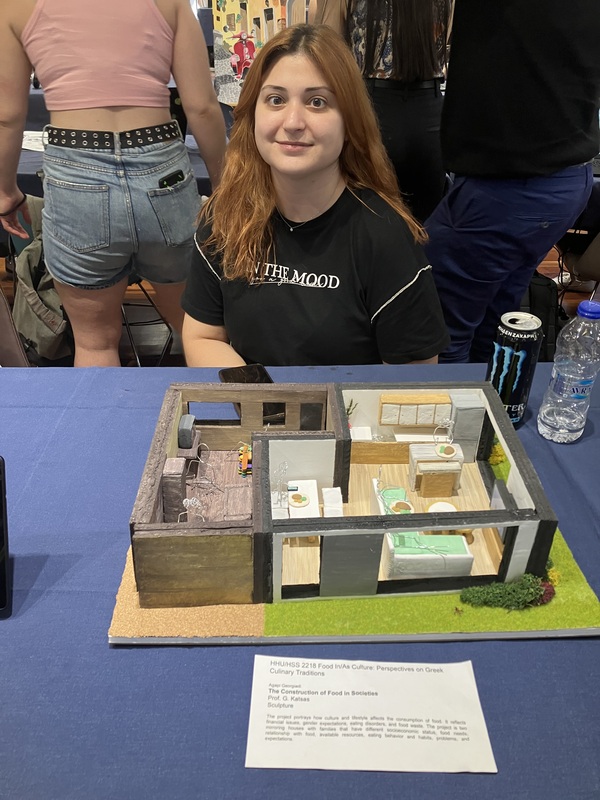
The project portrays how culture and lifestyle affect the consumption of food. It reflects financial issues, gender expectations, eating disorders, and food waste. The project is two mirroring houses with families that have different socioeconomic status, food needs, relationship with food, available resources, eating behavior and habits, problems, and expectations.
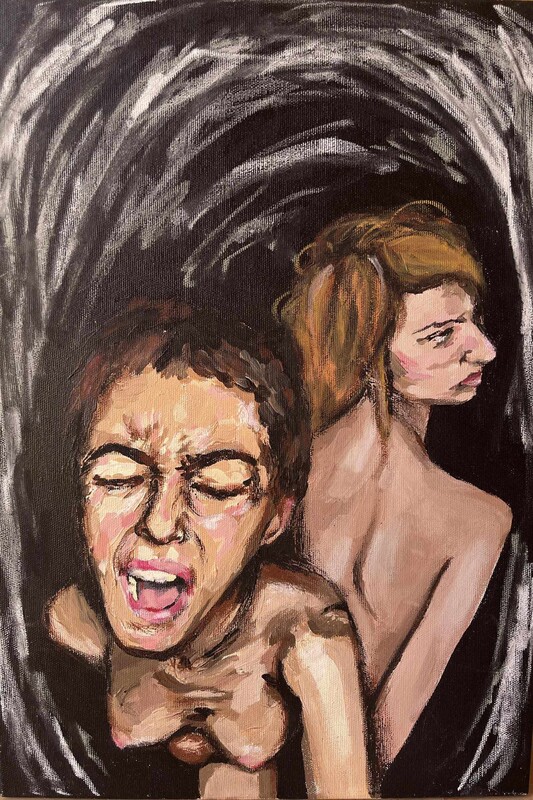
My project is a diptych containing of a 50x35 cm and a 24x18 cm work, made of acrylics, oil pastels and acrylic markers on canvases. In my work, I reflected on the concept of sisterhood, as portrayed in Sophocles’ (441 BC) tragedy Antigone, between Antigone and Ismene. Essentially, the relationship of Antigone and Ismene poses an excellent example of the complexity of sisterly connection, which also interrelates with the notions of motherhood and womanhood. Therefore, I aimed at portraying the intensity of this family dynamic that is represented in Antigone, by employing visual arts practices.
In this short animated film, I explore how modern women might find pieces of their everyday life reflected in the story of Antigone, thus becoming an Antigone themselves. I wanted to highlight how carving the path you want to follow is not always easy and dilemmas often come up between what one “has” to do and what they actually want. In that case, the mere act of self-determination can sometimes be rebellious.
My project is an application to study and simulate the replication functions of common Retroviruses and viruses. It uses scientific data from popular scientific and biology databases like https://www.ncbi.nlm.nih.gov such as viruse’s genomes and the scientific library of Biopython to simulate. It creates and presents the new RNA chain of the virus after the infection and the transcription process and its protein chain after the infection. It also showcases a pseudo-statistical analysis of the DNA mutation of the infected organism by taking into account the real-life mutation ratio of the specific virus. Whilst, this program is just a demo and with not much scientific evidence, I believe that with the correct scientific direction and experience of Dr. Valahas it could be something valuable in the future.
"Who Did It?" is a game show designed to make learning about infectious diseases engaging and entertaining. Set within the eerie confines of a haunted house, the game positions players as investigators tasked with solving mysterious deaths. As participants explore various rooms and encounter staged "dead bodies," they must collect clues and use their knowledge to determine the infectious disease responsible for each death. This educational approach not only enhances participants' understanding of epidemiology and disease pathology but also employs a unique narrative and interactive gameplay to maintain excitement and curiosity.
Putrid, suppurative, inflamed, diseased…
To me, the bubonic plague dresses fashionably in a little black dress, a mortal nod to Coco; tuberculosis is wispy, ethereal, pallid; and syphilis dons couture, sickly ostentatious. Each sports its history, its iconography, its oeuvre one might say.
Pesta, the fashion collection, corporealizes the imponderabilia of disease in 9 distinct looks, suffused in their motifs and literature and egregious beauty.
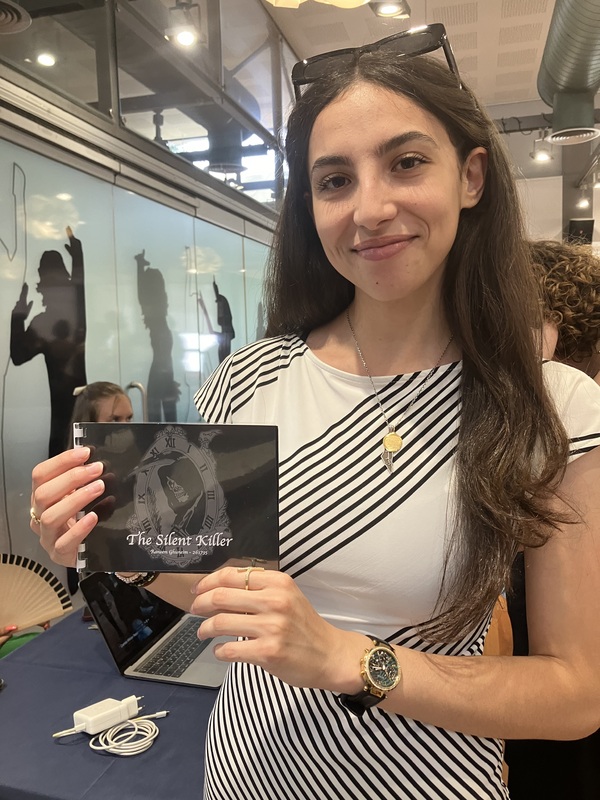
I was inspired by Albert Camus’ “The Plague” to write my own narrative/poem on how society may react to an unknown force. To make my project more innovative, I chose a poetic style to paint a figurative picture and appeal to readers’ emotions. With the “Silent Killer” as a metaphor to an infectious disease, the narrative captures the physical, emotional and psychological challenges faced both on an individual and collective level. Although my narrative does not target a specific pathogen, it indicates the general societal reaction to any widespread infectious disease. Finally, I drew the illustration on the title page of the book which portrays a grim reaper in a clock to illuminate the metaphors of death and time.