This research analyzes the role of the Arab Spring in media attention and treatment of the Kurdish Question and offers the significance of historical events in shifting approaches in Western media even for most ignored or marginalized cases such as the Kurdish Question. I specifically focused on right-wing (Daily Mail and Le Figaro) and left-wing (The Independent and Le Monde) online newspapers in the UK and France to determine the volume of news articles and shifts in narratives from Iraq's recognition of Autonomous Kurdistan in 2006 to the Arab Spring, and finally from the Arab Spring to the PKK insurgency in Turkey in 2015-16.
How has the 2025 inauguration of Donald J. Trump affected the levels of online hate-speech? This is the question I am trying to address through this paper, particularly by focusing on the realm of social media. I consider public online discourse through 240 YouTube comments under politically relevant content before and after the inauguration, and I compare the presence of hate-speech using a predetermined set of 64 hate-containing keywords. By analyzing the difference in the trends between these two periods I conclude that hate speech has risen by an aggregate of 47.8% and I interpret my data through academic sources within a mixed methods analysis.
This paper explores how surveillance on social media platforms contributes to the death of democracy, and how users become complicit in this process. By examining concepts like deliberative democracy, surveillance capitalism, and data colonialism, the study highlights the ways in which targeted data collection can distort political discourse and public opinion. It argues that these platforms foster polarization, reinforce biases, and limit exposure to diverse perspectives, thus, weakening democratic processes. Finally, the paper concludes with a survey analysis that evaluates the social media habits of users, their surveillance awareness, the perceived impact of surveillance on democratic values, and their motives behind sharing private information, providing valuable insight into the role of digital surveillance in undermining democracy.
In this presentation, I will analyze three key online advertising campaigns by
Gucci (2018-present) through semiotic and semantic lenses. I'll explore how
Gucci’s messaging reflects its relationship with society, addressing themes like
sustainability, diversity, and self-expression. The discussion will also critically
examine how these campaigns influence both societal norms and individual
identities, shaping luxury consumption in the digital age. By examining Gucci's
evolving brand communication, I’ll highlight its role in creating cultural relevance
while influencing consumer behavior and societal values. References used will be
up-to-date, from 2018 onwards.
This paper sets out to explain the views of Plato and Aristotle on the body-mind issue and identify the differences between them. On Plato, the aim is to lay out his theory on the tripartition and the immortality of the soul, as well as the development of both doctrines, through examination of textual evidence. On Aristotle, the focus is on the definition of the soul as an entelecheia, and the explanation of the distinction between passive and active intellect. For the thesis of this paper, what is attempted to be shown from the comparison of these two philosophers’ theories is the ultimate core difference in their ways of thinking, namely the mystical versus the pragmatic.
This work examines how luxury fashion influences society and personal identity. It explores key principles like sustainability, culture, economics, technology, and psychology. Luxury brands shape social status, self-expression, and cultural values while impacting the economy and ethics.
This paper examined the attitudes of students and faculty towards academic uses of AI Chatbots, as well as students’ awareness of academic integrity principles surrounding AI usage and the ability of both faculty and AI detection software to distinguish between human and AI-written text. Findings include a positive outlook towards AI chatbot usage in both faculty and students, as well as approximately half of the student participants being able to respond correctly when asked about appropriate and inappropriate uses of AI. Additionally, neither AI detection software nor faculty members were able to consistently differentiate between AI-written and human-written text.
This essay examines the similarities between artificial intelligence (AI) and the authoritarian elements depicted in George Orwell's ‘1984’. It discusses current issues related to surveillance, manipulation, and control facilitated by AI. The impact of AI on various fields, including entertainment, health, and journalism, is analyzed, alongside the influences of early AI thinkers. The work also applies Marshall McLuhan's "Medium Theory" to evaluate contemporary practices. Ultimately, the essay argues for the importance of user education and the establishment of legal protections for personal data to maintain human agency and moral values, ensuring that Orwell's dystopian vision does not come to fruition.
What should you wear to go sailing? In this installation, I suggest a new uniform
for sailing by presenting a series of outerwear, crafted out of sails and other
materials sourced from “Alter Ego”, my grandfather’s sailing yacht. Inspired by the
mise-en-scène of a sailboat, the work appears as a series of hybrids between
space, sculpture and garment that negotiate form, materiality, utility, and status.
What kind of self is stitched into these materials?
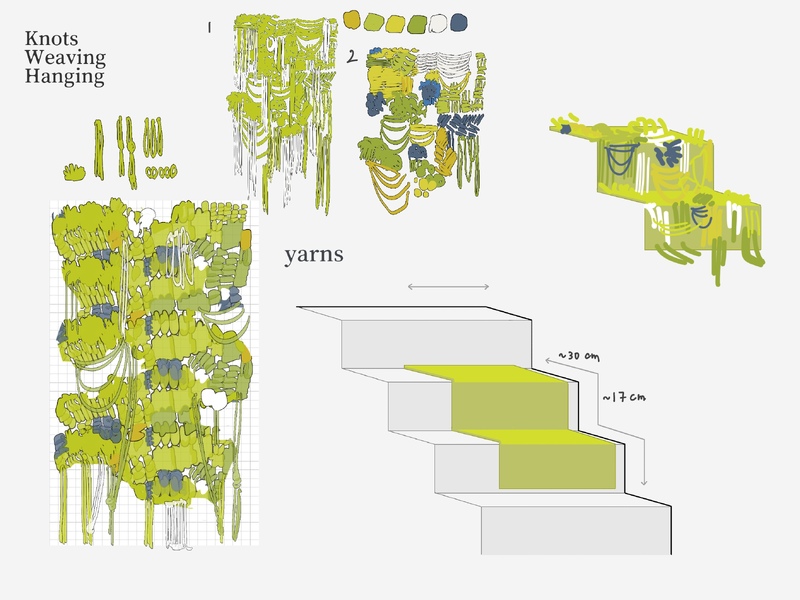
The sculpture Moss is a soft sculpture carpet which weaved with yarns to mimic the feature of nature. The intention of creating the Moss Carpet is to interact within the natural environment, meanwhile attach to the physical surroundings. The carpet is weaved with various yarns, in differing color and texture, which combined together presenting the organic form of moss and natural fibers. The sculpture represents the combination of the tradition technique in weaving and the fragility of nature, while conveying the feminine quality associated with the fabric sculpture. Psychologically, the work evokes a sense of curiosity and intimacy. The nature quality of the softness and warmth in yarn invites engagements mentally, makes the viewer want to touch and feel the piece.