A Fairy Tale guide which aims to present clear expectations from the classic fairy tale heroines as narrative “rules.” As well as, reveal how survival and success in a patriarchal society depend mainly on female kindness, obedience, sacrifice and emotional labor.
Peter the cat was born blind, but she lives her life just like any other cat! She can move around spaces with ease and if she needs any help navigating she communicates with her owner through touch and sound. She runs around the house and plays with different objects as all cats do. Blind cats do require a bit of extra help, but they can play and cuddle just like any other cat. Don’t feel sorry for Peter because she’s blind, she doesn’t even know she is. Adopting a cat might change your life for the better, but it will definitely change the cat’s life for the better.
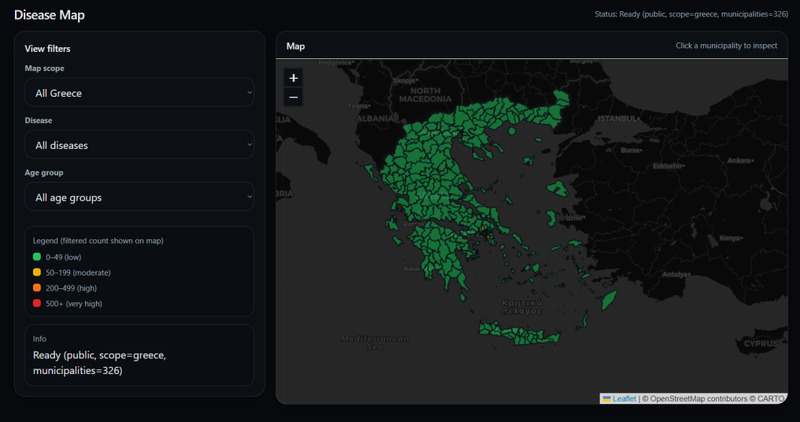
This project, in its current state, is a disease-visualization program designed to improve transparency on how diseases spread. It uses a map of Greece’s municipalities, color-coded by case levels (green: 0–49, yellow: 50–199, orange: 200–499, red: 500+). Each report includes disease-id, age-group (0–18 / 19–64 / 65+), municipality and doctor-id. The system has three user types: public (view data), doctor (submit reports) and admin/dev (manage doctor accounts and disease types). It allows municipalities to make informed decisions and helps detect patterns to prevent wider outbreaks, while also being adaptable to other countries and datasets.
To Be Seen is To Be, is a sculptural piece that draws from the potent imagery of the cave-tomb of Sophocles’ Antigone, but also from Athol Fugard’s The Island, and Achille Mbembe’s Necropolitics and aims to explore how systematic state violence renders certain lives invisible. The sculpture takes the form of a cave with its entrance barricaded with stones and wire, a direct connection to Antigone’s tomb but reimagined with contemporary elements, and examines themes of civic erasure, resistance, and social death in the contemporary world.
The creative project “Faces of Death” explores different perceptions of death, found in music from around the world. Specifically, it presents six thematic perspectives: death as the ascension of the soul, cosmic mystery, pain, sadness and loss, catharsis and celebration/continuation of life. Drawing from musical examples from Tibetan Buddhism, classical music, African, Mexican and Ainu music, the project aims to showcase the way music functions as a medium to express the above perspectives. The format is a 90-minute concert program with representative examples of each category.
The intent of this project is to explore decay in architecture and make a connection between ancient and modern ruins. The collage is a depiction of the Acropolis assembled from photographs of abandoned buildings covered in graffiti from all over Athens. Unlike preserved heritage sites, that communicate a timelessness, but also feel distant and disconnected from contemporary life, modern ruins display how abandoned structures can evolve with the community and invite new interpretations. This project does not aim to diminish the cultural importance of ancient ruins, but to explore how together, they reflect different forms of memory and cultural expression.
ēchai Athēnōn (“Echoes of Athens”) is an audiovisual work composed of field recordings gathered from Athens, which are paired with imagined sonic and visual reconstructions of everyday life. Based on Georg Simmel’s observation that visual impressions in the metropolis are fleeting and fragmented, while sound structures social interaction, the project aims to foreground the city’s soundscape and the afterimages it creates, to reveal how everyday sensory experiences shape perception, evoke both closeness and detachment, and reflect the utopian and dystopian rhythms of urban life.
The aim of this project is to visually display and discuss the commodification and exploitation of Indigenous aesthetics for Western consumption. Using the typical dress from the Puruhá Indigenous group of Ecuador as a frame of reference, this work demonstrates how racial biases and exploitation mechanisms found within the fashion industry are replicated within generative AI even when prompting for minimal deviation from the original input. Utilizing Umberto Eco's lens in Faith in Fakes, this work discusses the distortion of the generated images in relation to colonialism within the primitivist and exoticist art styles, highlighting Indigenous erasure and objectification.
This project was an attempt to use AI to create concept images for a fictional Greek settlement near modern-day Afghanistan. The rationale was to mix and match contrasting pieces of architecture, greco-roman and modern Bauhaus on an area where they do not exist, or ar not usually imagined. It was a process with three stages: creating the landscape, introducing one or two structures of recognisibly Greek origin, and finally adding a settlement. Creatively, this was an exercise in visualising alternate history, while technologically it was to test the limits of what AI could do.
I created a poster/illustration that aims to highlight some of the female/non-male authors that have contributed to the analysis and discussions surrounding the ancient Greek tragedy “Antigone.” Women have faced, and still to this day face, a lot of discrimination when it comes to joining academic discussions. The field of philosophy especially, is extremely male dominated, so it is important for their voices to be heard and uplifted. The passage on the poster is directly taken from the text itself, specifically from Antigone’s ode to love.