"The Lenses of Our World" is a painting that depicts a not-so-distant future – a clash of imagination and reality – where the allure of a digital “heaven” paints over the physical world. My project uses biblical imagery of heaven and hell to question how devices like the Meta Ray-Ban Display glasses reshape our perception. Drawn in by the irresistible beauty of the AR world, I invite the audience to confront its corresponding reality: What will happen when digital perfection is more desirable than reality itself?
"Unmourned Deaths" is a collage/painting showcasing issues such as animal abuse, environmental pollution, and exploitation. These issues are portrayed through a gravestone collage made from recycled household material and common waste that is known to be harmful to animals in the environment. The scope of this project is to raise awereness for the issues mentioned and create discussion regarding the deeper meaning of the unmourned deaths of animals in the farming industry and the enviroment.
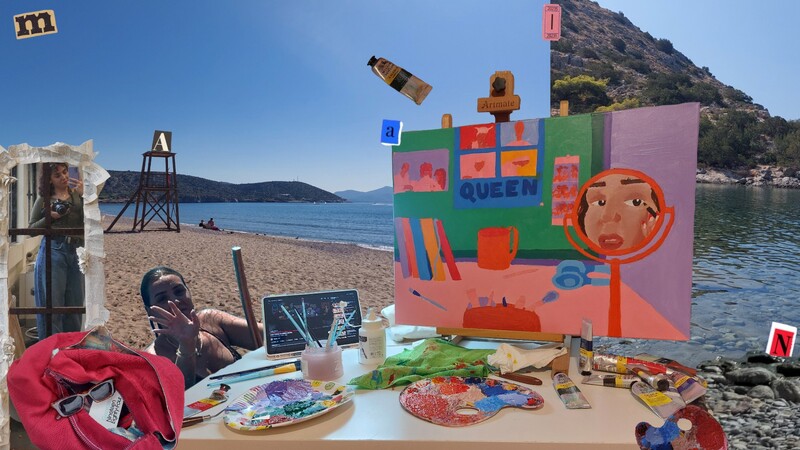
The work submitted was created as a final project in the Painting course (Prof. Effie Halivopoulou) and is meant to emulate my personality, through creating a painted collage. The main goal of this work was to combine physical places in which I feel most creative -the beach and my desk- along with incorporating relevant elements, such as brushes, palettes, and my beach bag. I consciously chose to keep the visual elements of the work flat and reminiscent of cartoons and comic books, inspired by many artists such as Matisse and Lichtenstein, instead of opting for a photorealistic approach.
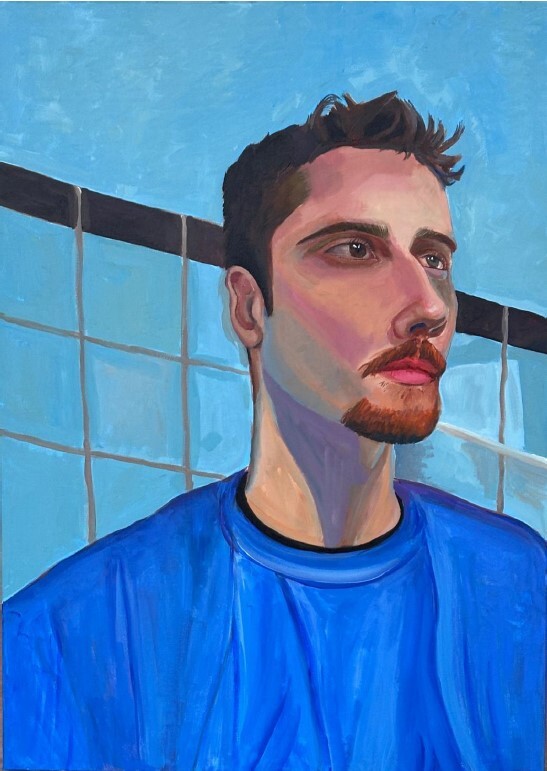
I began with a cool-toned blue underpainting to break from my usual warm palette, aiming for brighter colors. Using burnt sienna, I sketched the figure and built layers, mixing skin tones directly on canvas with wet-on-wet techniques. I painted the background and clothing in multiple coats, experimenting with ultramarine and violet for depth. I used black pigment for the first time in years, which felt liberating. Inspired by Alice Neel and Alpay Efe, I exaggerated facial features and layered tonal values. This painting helped me grow, combining familiar methods with new techniques and boosting my confidence with a new color palette.
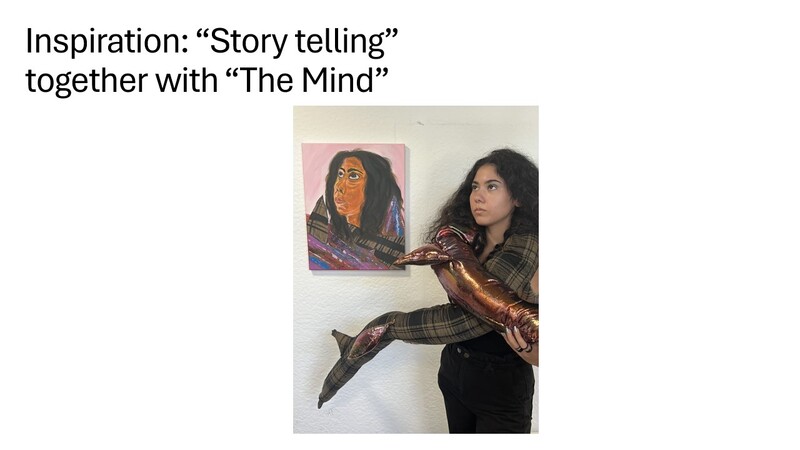
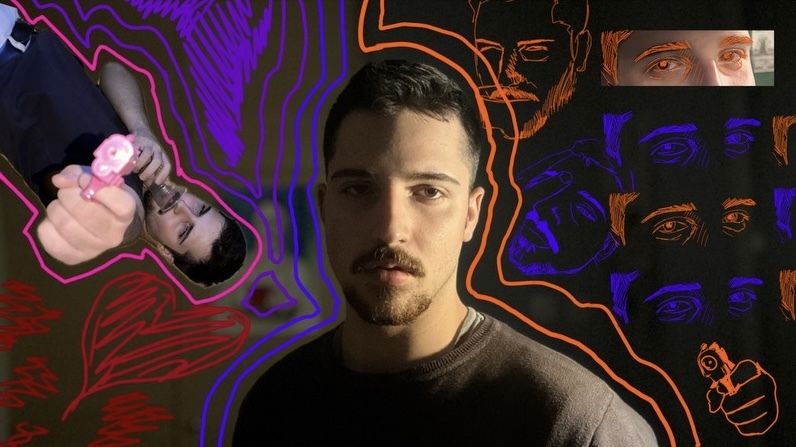
This is a self portrait in acrylic paints. It shows a close-up of my face, the face of the artist, looking up, optimistically but also melancholically. The picture is surrounded and even choked in a way, by a past work of mine, “The Mind”, which is a soft, wearable sculpture. The result portrays my suppressed feelings, desires and fears.
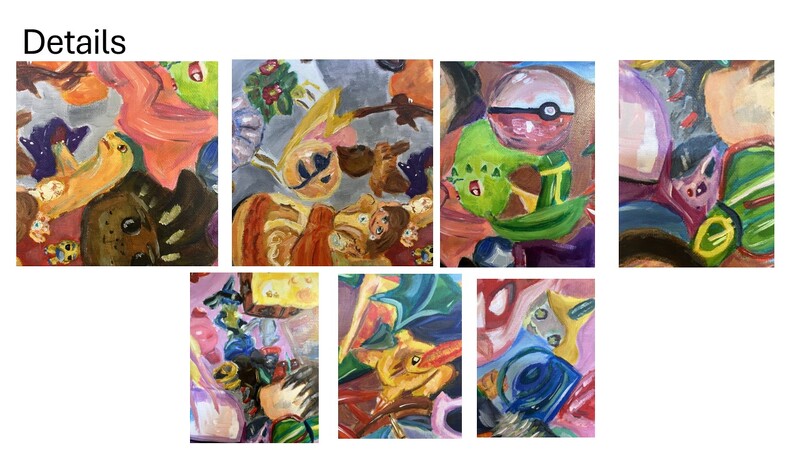
“Best of Both Worlds” is a 50x70 cm painting with acrylics on canvas. It portrays a pile of toys, consisting of figures, plush toys and other objects in a busy, colorful and chaotic composition. Somewhere amongst the pile, I inserted my self-portrait, looking up at the viewer. This way, I become part of the fantasy world of video game toys. It is a project which describes a collage of different images that takes place in my favorite comfort space, which is my room. It is an artwork honoring childhood memories and nostalgia.
In this artwork, I explore identity, personal growth and emotional contrast through bold color combinations and other collage-like painted elements. Using self-photography as a base, I created 2 portraits, 1 calm and introspective, the other playful and social. Reflecting different facets of myself. Through expressive brushstrokes, layered compositions, and contrasting tones, I highlight the tension between introversion and the need to adapt in social places. The use of mismatched colors symbolizes change and the discomfort of growth, but I also picked those specific ones to embrace that I grew out loving them even though I remember disliking orange, green, brown as a teenager, I only liked blue and black. But here we have a combination of both juxtaposing symbolizing again change and adaptation.
The painting depicts a medieval physician in the middle wearing a long leather robe and a ‘headpiece’ that resembles the beak of a bird, filled with herbs. The recipe of herbs was believed to protect against poisoned air or miasma. The physician is seen holding a book with an image of human anatomy and a heart which represents an attempt to understand the disease. In the other hand the physician is holding scissors which represents the medieval ways to treat the sick.
In the top right, fire is depicted as it represents chaos and destruction. In the bottom right two rats are spotted as they are the image of the black death. However, the rats weren't the cause of the disease, but they carried fleas that were infected with the bacterium yersinia pestis that caused the infection. In front of the physician is a coffin that represents death.
It is an oil painting with a golden frame (made from golden paper). It depicts a visibly ill noble lady in pink dress, being dressed by two maids. In further front there are two painters painting the scene with the noble lady and the maids. The background is of a noble lady’s bedroom (with a bed and a vanity table to the right). At the top of the right corner there is a white death holding the scythe on one hand and the hourglass on the other, which is an embodiment of Tuberculosis “The White Death” depicted in many artworks of early 19th century.
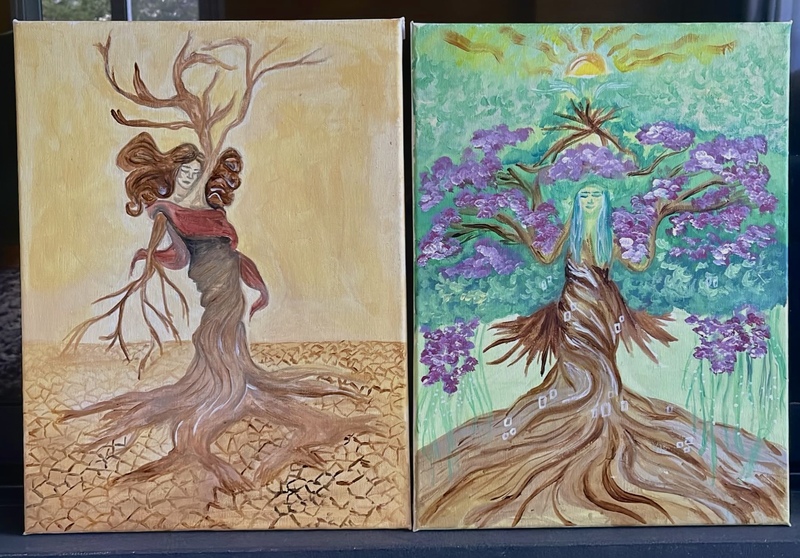
Once upon a near future, we imagined two Earths. One, dry and broken, shaped by our silence. The other, alive and breathing, shaped by our will to act. Between them stands a figure, part human, part tree, holding the tension of choice. Our painting tells this story, not as a warning, but as a possibility. A future still open, still waiting for us to act, either with care or with ignorance, until the “critical deadline”.
Which future will you choose to live in?