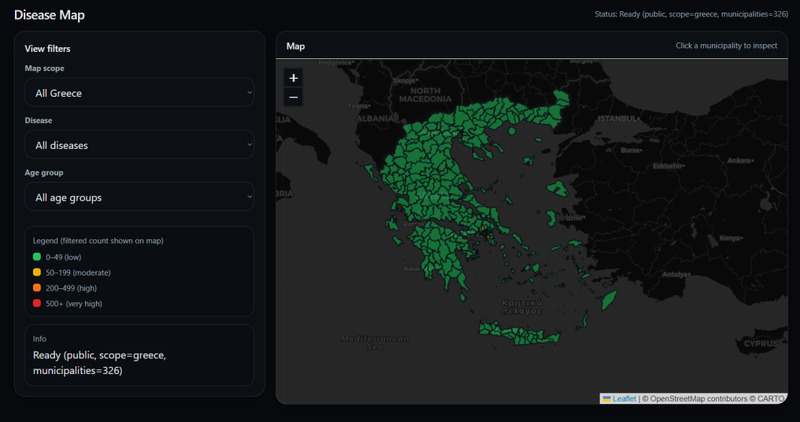
This project, in its current state, is a disease-visualization program designed to improve transparency on how diseases spread. It uses a map of Greece’s municipalities, color-coded by case levels (green: 0–49, yellow: 50–199, orange: 200–499, red: 500+). Each report includes disease-id, age-group (0–18 / 19–64 / 65+), municipality and doctor-id. The system has three user types: public (view data), doctor (submit reports) and admin/dev (manage doctor accounts and disease types). It allows municipalities to make informed decisions and helps detect patterns to prevent wider outbreaks, while also being adaptable to other countries and datasets.
A fully functional , deployed e-commerce web application for an imaginary company, with a range of dynamic features. These include:
A products/services catalogue
Search items by name and filter by category functionalities
User registration, login/logout, profile viewing and updating
Role-based and Web security
A shopping cart system and checkout functionality
Other advanced features
Public users: Can browse items and register/login
Members: Can order items, configure their profile and access most of the website
Staff members: Members capabilities + employee portal access
Superuser/Admin: Members capabilities + admin portal access
I created a website that sells flowers, accessories for gardens, fertilizers and more. The user can login or register or checkout as a guest. The logged in users can view and edit their profiles, view their shopping card, view their order history, make an order, and rate. The staff can also edit the product, and the owner can also delete a product, add a product and register staff. They can search for products through the search bar or to use the categories and subcategories.
This project develops a Sustainable Development Goals (SDG) platform to promote campus sustainability through interactive education. The system features:
1. SDG Awareness Hub – Displays all 17 UN goals with definitions and campus examples.
2. Interactive Quiz – Tests knowledge with SDG-focused questions and tracks scores.
3. Collaborative Blog – Allows students to share sustainability projects (images/videos stored securely via Cloudinary).
4. Admin Dashboard – Manages content moderation and user engagement.
Built with the MERN stack (MongoDB, Express, React, Node.js), the platform bridges theory and action by encouraging student participation in sustainability initiatives.
Impact: Enhances SDG literacy while documenting real-world campus projects.
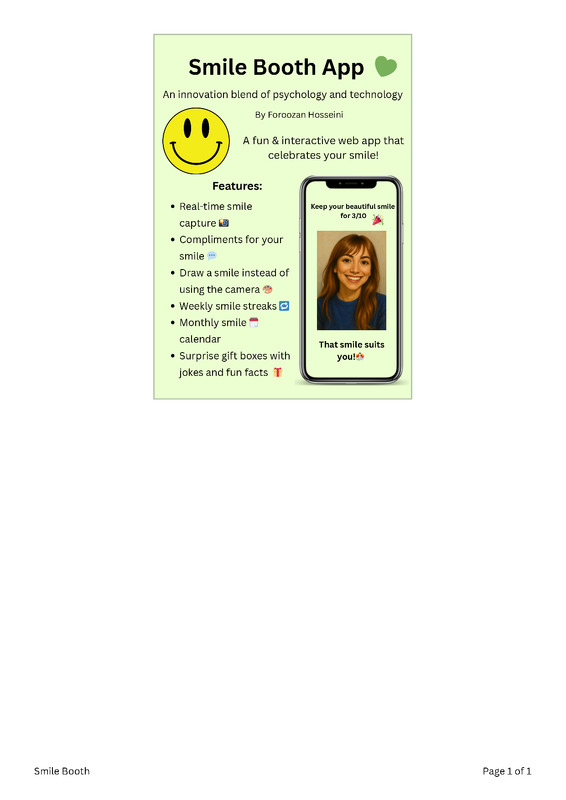
Smile Booth is an application designed to encourage users to smile. It detects the smile of users in real time using AI and counts the smile over 10 seconds; then rewards users for recording their smile. For days that users may not feel using camera, it offers a creative feature to draw a smile and write a positive sentence. Smile Booth also includes a fun page with two giftbox - One relives a joke and the other a fun fact. On the Callander page, it shows the days of the month and the number of smiles that users recorded. It is simple to use, user friendly, and made to spread positivity.