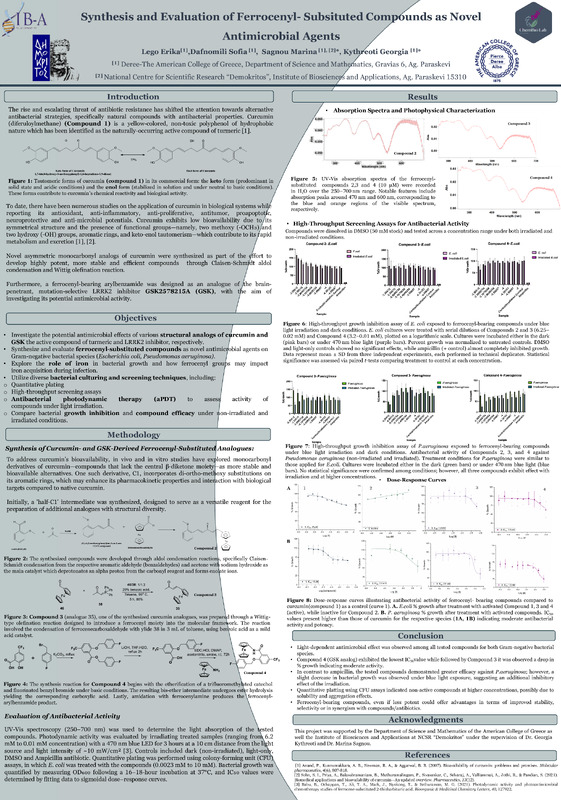
The rise and escalating threat of antibiotic resistance has shifted the attention towards alternative antibacterial strategies, specifically natural compounds with antibacterial properties. Curcumin (diferuloylmethane) is a yellow-colored, non-toxic polyphenol of hydrophobic nature which has been identified as the active compound of turmeric. Curcumin’s antioxidant and anti-inflammatory properties are well-studied, but its poor absorption and rapid metabolism limit its bioavailability. This project aims to examine the potential effects of different structural analogs of curcumin, the active compound of turmeric. Specifically, various curcuminoid derivatives bearing ferrocenyl groups were synthesized and evaluated for their antimicrobial potential. This approach is based on the pivotal role of iron in bacterial growth and proliferation, as bacteria rely on iron scavenged from their environment to survive during an infection when the host limits iron availability to suppress pathogen proliferation. These analogs were tested against Gram-positive and Gram-negative bacteria Escherichia coli, Staphylococcus aureus, and Pseudomonas aeruginosa. Bacterial culturing methods included quantitative plating, high-throughput screening assays, and antibacterial photodynamic therapy (aPDT) to evaluate growth inhibition and compound activity under light irradiation.
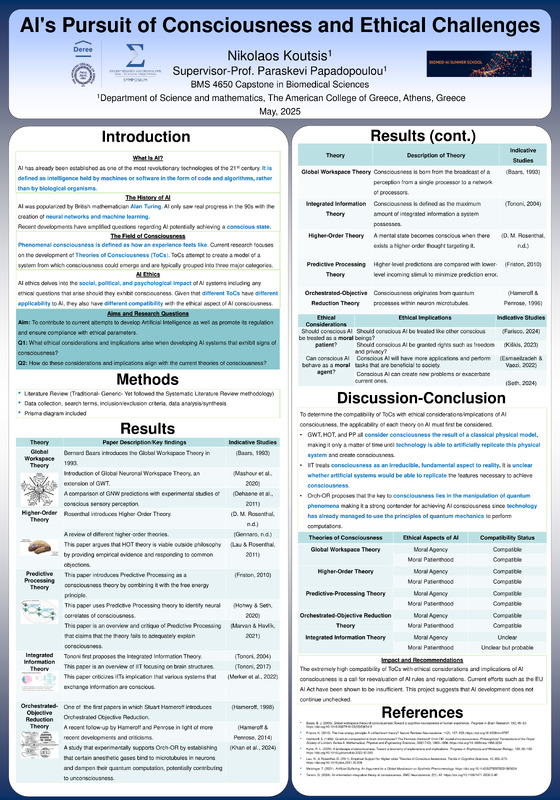
The work presented will be a poster presentation of my capstone project. The paper was a literature review on the nature of consciousness, AI, and the ethics surrounding it. Five prominent theories of consciousness were reviewed and their applicability to AI was assessed. The ethical considerations and implications of AI consciousness were addressed and their compatibility with each theory of consciousness was determined. Findings of high levels of both applicability and compatibility lead to the proposal of increased regulations on AI development to ensure compliance with moral constraints.
Voltage-gated sodium channels (Nav) are crucial for neuronal excitability and action potential propagation. This study integrates X-ray crystallography, AlphaFold 3 predictions,
cryo-EM, and ligand interaction studies to analyze the generic Nav structure and function. AlphaFold 3 predicts key regions,
cryo-EM captures dynamic states, and X-ray crystallography provides atomic-level resolution. Ligand studies reveal modulation by toxins and drugs. Comparing these methods highlights their strengths in resolving structural dynamics. Integrating computational modeling, experimental validation,
and ligand studies enhances neurobiology education by bridging theoretical concepts with practical applications in protein structure-function analysis.
Authors: Athanasios Koranis, Eirini Tzermpou, Sofia Orfanou, Paraskevi
Papadopoulou
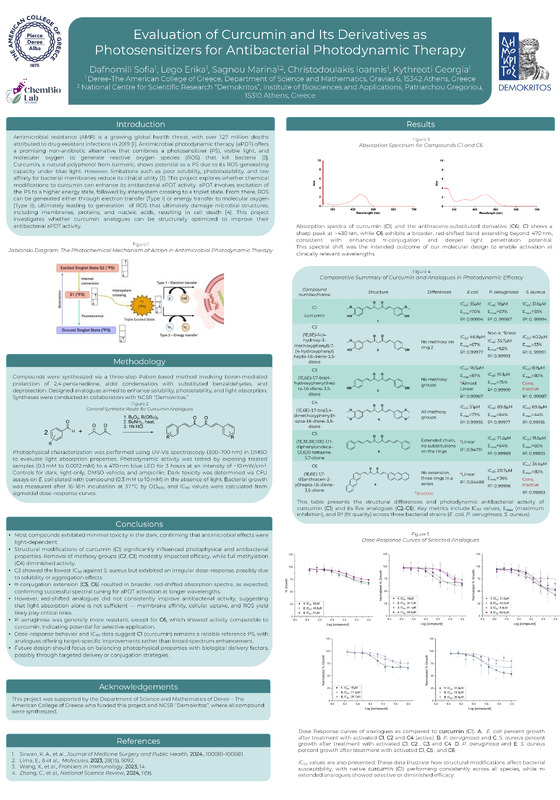
Antimicrobial resistance (AMR) demands alternative strategies beyond conventional antibiotics. This study evaluates curcumin and five synthesized derivatives as photosensitizers for antimicrobial photodynamic therapy (aPDT) against E. coli, P. aeruginosa, and S. aureus. UV-Vis spectroscopy characterized their absorption profiles, while antibacterial efficacy was assessed using high-throughput growth inhibition assays under blue light irradiation. Results revealed that structural modifications influenced both photophysical properties and antibacterial performance. Several derivatives demonstrated improved or comparable efficacy to native curcumin, particularly against Gram-positive bacteria. Findings highlight structure-activity relationships critical for enhancing aPDT agents and suggest avenues for further optimization in treating superficial bacterial infections.
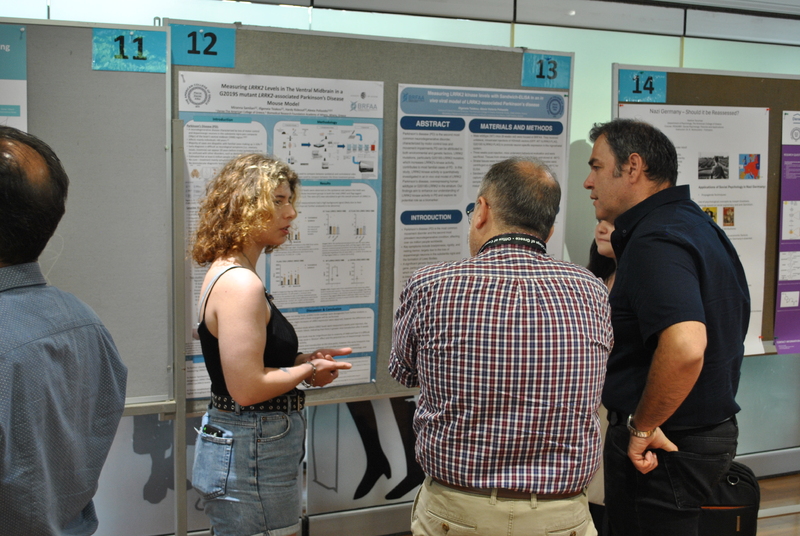
The project is about the measurement of LRRK2 kinase levels in striatum with Sandwich-ELISA in an in vivo viral model of LRRK2-associated Parkinson’s disease. LRRK2 is a protein, encoded by the LRRK2 gene and the variants of this gene are associated with familial and idiopathic Parkinson’s disease (PD). The importance of LRRK2 levels and their relationship to PD pathogenesis is crucial for understanding underlying mechanisms of the disease and such models are crucial to test new LRRK2-targeted treatments for PD.
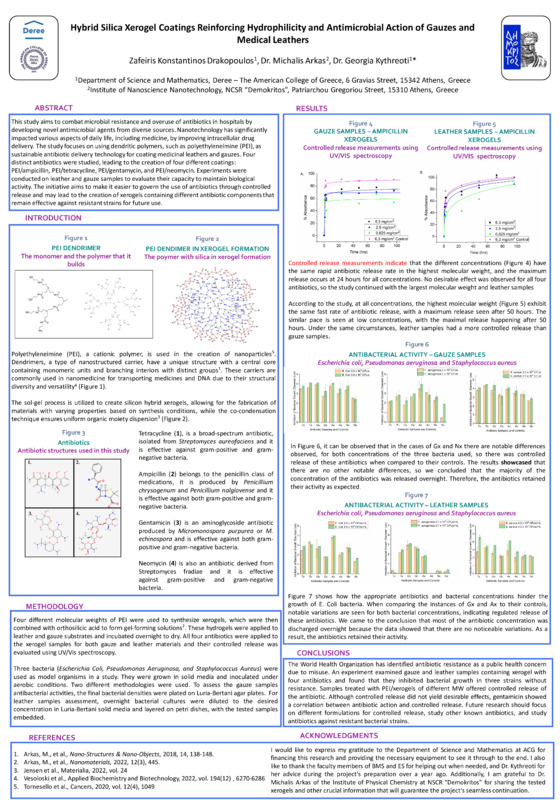
This study aims to combat microbial resistance and overuse of antibiotics in hospitals by developing novel antimicrobial agents from diverse sources. Nanotechnology has significantly impacted daily life, including medicine, by improving intracellular drug delivery. The study uses dendritic polymers, polyethyleneimine (PEI), to create sustainable antibiotic delivery technology for coating medicinal leathers and gauzes. Four different antibiotics were studied. Experiments were conducted to evaluate the coatings' ability to maintain biological activity in treated leathers and the xerogel with antibiotics combination. This initiative aims to regulate antibiotic use through controlled release and create xerogels with different antibiotic components for future use.
Parkinson’s disease (PD) is a neurodegenerative disorder characterized by the loss of motor control and dopaminergic neurons in the substantia nigra pars compacta region in the ventral midbrain. Only 5-10% of PD cases are familial, with the most common dominantly-inherited gene being LRRK2. LRRK2 holds a high potential as a PD biomarker due to its hyperactive kinase function associated with idiopathic PD and mutant LRRK2-induced PD, where G2019S is the most common pathogenic mutation.
Methodology: In-house Sandwich ELISA was used to measure total LRRK2, flag-tagged LRRK2, and
phosphorylated LRRK2 levels in the ventral midbrains of mice 3-weeks post-injection with helpful adenovirus vectors to induce LRRK2 expression.
Results: Differences were observed in LRRK2 levels between treatment groups, however they were found to be insignificant 3-weeks post-injection. For future research, larger cohorts and measuring LRRK2 levels at later time-points should be considered.