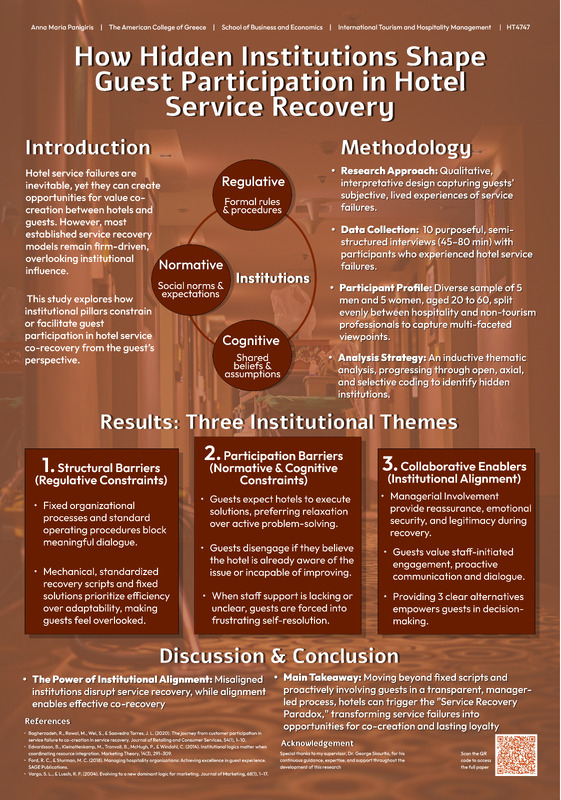
"This dissertation investigates how regulative, normative, and cognitive institutions at the micro-level, shape customer actors' service recovery behaviors, expectations, and co-recovery processes within hospitality service ecosystems. By zooming in on customers during service failures, it identifies which institutions facilitate or constrain the co-creation of recovery solutions when service failure occurs."
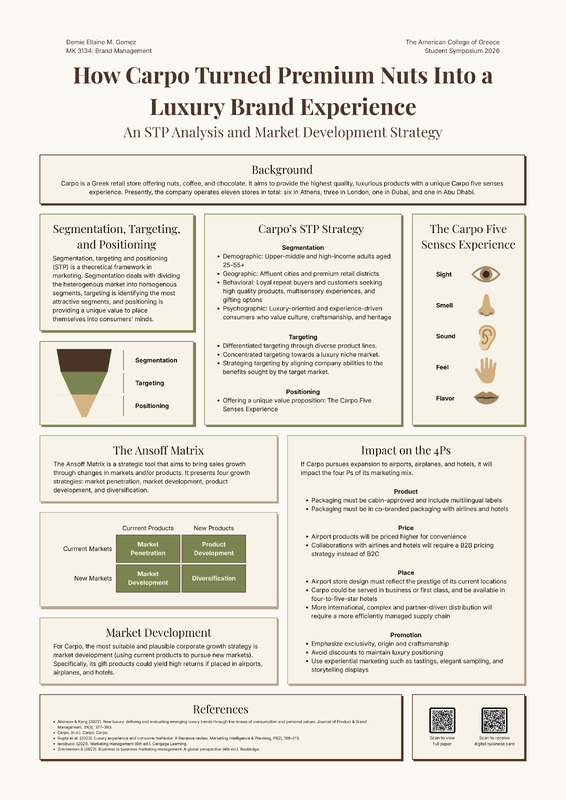
This paper analyses how Carpo applies the Segmentation, Targeting, and Positioning (STP) framework to establish a premium brand in the nuts, chocolate, and coffee market. Since launching in Kolonaki in 2011, Carpo has targeted quality-conscious, experience-driven consumers through high-end products and curated retail environments. The study evaluates how this positioning differentiates Carpo from competitors and supports its expansion strategy. The findings indicate that Carpo’s competitive advantage lies in combining product excellence with experiential branding, enabling strong market differentiation and scalability within the premium segment.
Business-to-business marketing activities are typically more complex as it must consider technical, economical, and relational factors. Therefore, it is important to understand organizational buying behavior, as businesses select its suppliers not only based on price, but also based on the decision-making units, perceived risks, and long-term value. This paper analyzes and studies the case of Midlands Switchgear Ltd by the roles of its DMU in supplier selection and its market segmentation strategy. Specifically, this paper evaluates the firm’s supplier selection criteria, cross-functional decision-making dynamics, and discusses options for strategic segmentation.
Carpo is a retail store founded in Athens, Greece, offering nuts, coffee, and chocolate. It aims to provide the highest quality, luxurious products with a unique Carpo five senses experience. In 2011, Carpo expanded its market, opening a store in Kolonaki, one of the most prestigious neighborhoods in Athens. Then, in 2013, it opened its first international store in London. Presently, the company operates eleven stores. This written report critically analyzes Carpo’s segmentation, targeting, and positioning strategy. The Ansoff Matrix is used to derive four corporate growth strategies, one of which is extensively discussed and applied in Carpo’s marketing mix.
Luxury branding shapes fashion, society, and identity by symbolizing status, exclusivity, and aspiration. My essay explores key principles like heritage, craftsmanship, and personalized experiences, alongside theories such as Veblen’s conspicuous consumption and Maslow’s hierarchy of needs. It examines fashion as a social signifier and self-expression tool, analyzing how luxury brands influence self-perception and societal structures. A case study on Chanel highlights luxury's role in social stratification and cultural identity. Psychological aspects, peer influence, and digital shifts further emphasize how luxury branding impacts modern consumer behavior and evolving societal norms.
This research investigates the key principles and evolving theories underlying luxury brand management—an intricate field where exclusivity, heritage, and innovation converge to serve the expectations of high-end consumers. As luxury brands navigate contemporary values such as sustainability and inclusivity, their
role extends far beyond that of traditional status symbols. In 2024, these brands actively shape cultural narratives, influence societal trends, and serve as platforms for individual expression. This project aims to examine the complex relationship between fashion, society, and the self, while also analyzing the significance of luxury fashion brands both within society and as tools for self-construction. By bridging cultural analysis with brand strategy, the study offers insight into how luxury continues to evolve and remain relevant in an increasingly value-driven world.
My work consists of the key principles of luxury brand management, explaining why it is different from other types of brands. Also, my work explains the complex relationship between fashion, society, and the self and how they are all interrelated. Lastly, my work examines the role of a luxury fashion brand in society and for the self.