Genotoxicity screening and miRNA profiling of extracellular vesicles derived from human infrapatellar fat pad mesenchymal stem/stromal cells
"miRNA profiling and genotoxicity screening of extracellular vesicles derived from human infrapatellar fat pad mesenchymal stem/stromal cells
1. Molecular Cell Biology Laboratory, School of Science & Technology, Deree – The American College of Greece, Athens, Greece
2. Center of Clinical Research, Experimental Surgery and Translational Research, Biomedical Research Foundation of the Academy of Athens, Greece
3. Department of Orthopedics, UHealth Sports Medicine Institute, Miller School of Medicine, University of Miami, Miami, FL, USA
4. Diabetes Research Institute & Cell Transplant Center, Miller School of Medicine, University of Miami, Miami, FL, USA
* equal contribution
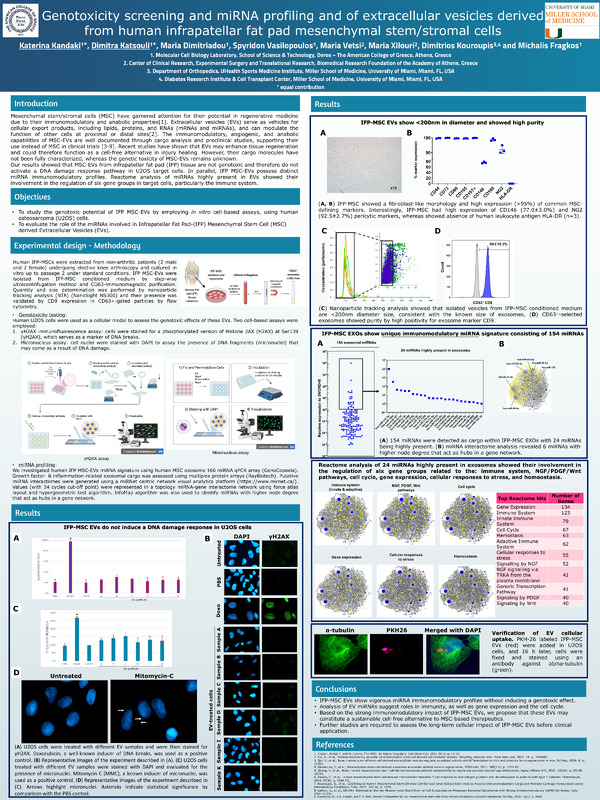
Introduction: Mesenchymal stem/stromal cells (MSC) have garnered attention for their potential in regenerative medicine due to their immunomodulatory and anabolic properties[1]. Extracellular vesicles (EVs) serve as vehicles for cellular export products, including lipids, proteins, and RNAs (mRNAs and miRNAs), and can modulate the function of other cells at proximal or distal sites[2]. The immunomodulatory, angiogenic, and anabolic capabilities of MSC-EVs are well documented through cargo analysis and preclinical studies, supporting their use instead of MSC in clinical trials [3-9]. Recent studies have shown that EVs may enhance tissue regeneration and could therefore function as a cell-free alternative in injury healing. However, their cargo molecules have not been fully characterized, whereas the genetic toxicity of MSC-EVs remains unknown.
Methods: In this study, human MSC-EVs originating from infrapatellar fat pad tissue (IFP) (1 male and 1 female, n=2) were examined for their genotoxicity, by performing two different in vitro cell-based assays. The first assay was based on a well-established nuclear marker of DNA damage, called γH2AX, by exposing human osteosarcoma cells (U2OS) to the EVs and performing immunofluorescence and microscope analysis. The second test, called micronucleus assay, involved the observation and analysis of small nuclei that appear next to the main nuclei of the cells and represent broken DNA fragments enclosed by a nuclear membrane.
Results: MSC-EVs from IFP tissue showed distinct miRNA immunomodulatory profiles. Reactome analysis of miRNAs highly present in EVs showed their involvement in the regulation of six gene groups in target cells, particularly the immune system. EVs internalization was confirmed by staining exosomes with a lipophilic dye, before exposing them to the target cells. In parallel, MSC-EVs were shown not to be genotoxic and therefore did not activate a DNA damage response pathway in U2OS cells.
Conclusion: Taken together our data show that MSC-EVs show robust miRNA immunomodulatory profiles and do not induce a DNA damage response, suggesting that their cargo does not include factors that could activate this pathway. Based on MSC-EVs strong paracrine immunomodulatory/trophic ‘medicinal’ activities, we propose a viable cell-free alternative to MSC-based therapeutics.
References:
1. Caplan, Arnold I. and D. Correa, The MSC: An Injury Drugstore. Cell Stem Cell, 2011. 9(1): p. 11-15.
2. Liu, X., et al., Immunomodulatory potential of mesenchymal stem cell-derived extracellular vesicles: Targeting immune cells. Front Immunol, 2023. 14: p. 1094685.
3. Qin, Y., et al., Bone marrow stromal/stem cell-derived extracellular vesicles regulate osteoblast activity and differentiation in vitro and promote bone regeneration in vivo. Sci Rep, 2016. 6: p. 21961.
4. Nakamura, Y., et al., Mesenchymal-stem-cell-derived exosomes accelerate skeletal muscle regeneration. FEBS Lett, 2015. 589(11): p. 1257-65.
5. Zhang, J., et al., Bone marrow mesenchymal stem cell-derived exosomes prevent osteoarthritis by regulating synovial macrophage polarization. Aging (Albany NY), 2020."